
If you travel across progressive agricultural belts in Maharashtra, Andhra Pradesh, Gujarat, or Madhya Pradesh today, you’ll notice a big shift in fruit orchards. Traditional, sprawling guava trees that take four years to yield significant fruit are quickly becoming a thing of the past.
Instead, forward-thinking Indian farmers are switching to high density guava farming in India. By growing more dwarf, manageable trees per acre and applying smart pruning strategies, commercial growers are doubling—and sometimes tripling—their per-acre profit.
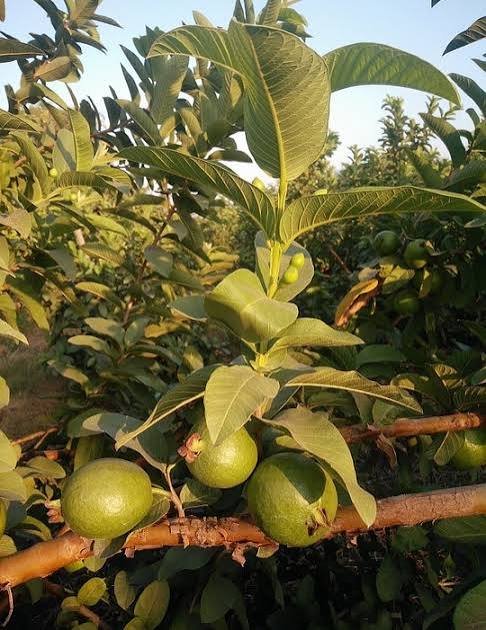
Guava (Psidium guajava), affectionately called the “Apple of the Tropics,” is no longer just a backyard tree. Thanks to modern techniques like Ultra High-Density Plantation (UHDP) and Meadow Orcharding, guava has turned into one of India’s most dependable, high-ROI commercial fruit crops.
Whether you are an established farmer looking to diversify or a new agri-entrepreneur planning your first commercial orchard, this complete guide covers spacing models, varieties, pruning calendars, real-world cost calculations, and per-acre profit potential.
Why Guava is Becoming a High-ROI Fruit Crop in India
For decades, Indian horticulture focused on crops like mango, citrus, and banana. However, guava has quietly emerged as an commercial favorite for several key reasons:
- Early Bearing & Faster Cash Flow: Traditional fruit orchards require 4 to 5 years before generating meaningful revenue. In contrast, high density guava farming in India yields commercial harvests within 12 to 18 months of planting.
- Year-Round Harvesting (Bahar Management): Through strategic pruning and irrigation management (regulating Ambe, Mrig, and Hasta Bahar), farmers can time their harvests during peak market pricing windows.
- Hardy Crop with Low Water Requirements: Guava trees thrive across diverse Indian soils—from light sandy loams to clay soils—and consume significantly less water per kilogram of fruit produced compared to sugarcane or paddy.
- Surging Market Demand: Urban consumers in India are paying premium prices for large, crisp, seedless, or low-seed table guavas such as VNR Bihi and Taiwan Pink.
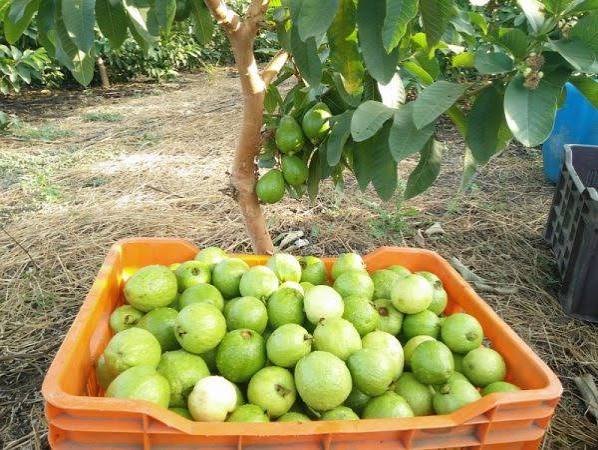
Traditional vs High-Density Guava Planting: A Quick Comparison
To understand why high-density guava farming in India delivers such impressive returns, let’s look at how it compares to traditional orchard methods.
In traditional planting, guava trees are placed 6 meters apart, allowing them to grow into massive, umbrella-like canopies. While individual trees grow large, most of the sunlight and land area goes unused during the early years. Spraying pesticides, harvesting upper branches, and controlling pests on a 20-foot tall tree also requires significant labor.
High-density and ultra-high-density systems flip this approach. By keeping trees compact through systematic canopy pruning, you maximize solar radiation per square meter, simplify pest control, and make hand-harvesting fast and easy.
| Parameter | Traditional Method | High-Density Plantation (HDP) | Ultra High-Density (UHDP / Meadow) |
| Plant Spacing | 6m x 6m or 5m x 5m | 3m x 3m or 3m x 1.5m | 2m x 1m |
| Plants per Acre | 112 to 160 plants | 444 to 888 plants | 2,000 plants |
| First Commercial Harvest | Year 3 or 4 | Month 18 to 24 | Month 12 to 15 |
| Average Yield (Year 3) | 4 to 6 Tons/Acre | 12 to 16 Tons/Acre | 18 to 25 Tons/Acre |
| Labor & Maintenance | High (Requires tall ladders) | Moderate (Ground-level work) | Low (Easy pruning & picking) |
| Drip Irrigation Efficiency | Low to Moderate | High | Very High |
Best Commercial Varieties for High Density Guava Farming in India
Choosing the right variety is the single most critical decision for your orchard. Your selection determines market price, shelf life, and suitability for high-density spacing.
1. VNR Bihi (The Premium Jumbo Guava)
Developed by VNR Nursery, this hybrid is the king of commercial guava farming in India.
- Fruit Characteristics: Extremely large (300g to 800g+ per fruit), crisp texture, low seed count, and an incredible shelf life of 12 to 15 days.
- Best Spacing: 3m x 1.5m or 3m x 2m.
- Market Advantage: Fetches premium wholesale prices (₹40 to ₹90/kg) in major urban mandis and supermarket supply chains.
2. Taiwan Pink / Thai Pink
An international favorite that has taken Indian horticulture by storm over the last decade.
- Fruit Characteristics: Deep pink flesh, attractive outer shine, mild sweetness, and medium size (250g to 400g).
- Best Spacing: 3m x 1.5m or 2m x 1m.
- Market Advantage: Highly popular among consumers for its attractive pink interior; produces heavy early yields.
3. Allahabad Safeda (The Evergreen Classic)
The standard traditional variety across North and Central India.
- Fruit Characteristics: Medium-sized, round, white flesh, rich sweet taste, and pleasant aroma.
- Best Spacing: 3m x 3m or 3m x 2m.
- Market Advantage: Excellent disease resistance and high local consumer demand across domestic wholesale markets.
4. Lalit (The Nutrient-Rich Pink Variety)
Developed by CISH Lucknow, Lalit is a high-yielding pink-fleshed variety.
- Fruit Characteristics: Saffron-pink pulp, balanced sweet-acid blend, and rich in jelly-making pectin.
- Best Spacing: 3m x 3m or 3m x 1.5m.
- Market Advantage: Performs exceptionally well in processing units as well as fresh fruit retail markets.
Spacing Models: Choosing Your Orchard Architecture
When setting up high density guava farming in India, choosing your spacing layout depends on your soil fertility, available capital, access to labor, and tractor machinery size.
       [ 3m x 3m Model ]                 [ 3m x 1.5m Model ]                [ 2m x 1m Meadow Model ]
   (444 Plants / Acre)               (888 Plants / Acre)                (2,000 Plants / Acre)

   O <─── 3m ───> O                   O <─── 3m ───> O                   O <─── 2m ───> O
   │              │                   │              │                   │              │
  3m             3m                  1.5m           1.5m                1m             1m
   │              │                   │              │                   │              │
   O <─── 3m ───> O                   O <─── 3m ───> O                   O <─── 2m ───> O
1. Moderate HDP (3m x 3m) – 444 Plants per Acre
- Who it’s for: Farmers with traditional machinery who want to lower initial seedling costs.
- Benefits: Allows easy inter-cropping (like legumes or vegetables) during the first two years. Easy movement for standard mini-tractors.
2. High Density (3m x 1.5m) – 888 Plants per Acre
- Who it’s for: The most popular sweet-spot layout for commercial guava growers in India.
- Benefits: Striking balance between plant population and management ease. Provides high early yield without overcrowding the root systems too quickly.
3. Ultra High-Density / Meadow Orchard System (2m x 1m) – 2,000 Plants per Acre
- Who it’s for: Progressive growers looking for maximum per-acre yields from Year 1.
- Benefits: Originally developed by CISH Lucknow, this system keeps trees restricted to hedge-like bushes under 2 meters in height. Every cultural operation—from pruning to harvesting—is done safely from the ground.
Planting Material and Nursery Selection
Your orchard’s lifetime success depends entirely on the health and genetic purity of your planting stock.
- Choose Air-Layered (Goothee) or Grafted Plants: Never plant seedling-raised plants; they take years to fruit and do not maintain genetic traits. Grafted or air-layered saplings ensure early flowering and uniform fruit quality.
- Nursery Accreditation: Source saplings only from ICAR/NHB-accredited nurseries or government horticultural stations. Request mother-plant lineage proof to avoid viral or fungal infections.
- Rootstock Health: Ensure planting material has a strong root system, a stem thickness of at least 1–1.5 cm, and zero signs of guava wilt or nematode galls.
Master Pruning Calendar: The Secret to High Yields
Without a strict, disciplined pruning schedule, high density guava farming in India will fail due to canopy overcrowding and light starvation. Guava bears fruit on new, emerging shoots. Therefore, pruning is the primary trigger that forces the tree to push out fresh flowering growth.
The 4-Stage Pruning Architecture
[ Plant Establishment (Month 1) ]  ──>  Cut main leader at 60 cm height
                                                 │
                                                 ▼
[ Primary Framework (Month 4-5) ] ──>  Retain 3-4 primary branches; head back by 50%
                                                 │
                                                 ▼
[ Secondary Canopy (Month 8-9) ]  ──>  Prune secondary shoots to induce 8-12 tertiary branches
                                                 │
                                                 ▼
[ Regular Maintenance (Post-Harvest)] ─> Annual topping & shoot thinning (May/June & Oct/Nov)
- Initial Heading Back (Month 1 to 2): After planting, cut the main stem at a height of 60 cm to 75 cm above ground. This stops vertical growth and forces the plant to push lateral side-branches.
- Primary Branch Selection (Month 4 to 5): Keep 3 to 4 well-spaced primary shoots pointing outward in different directions. Pinch off all other extra shoots.
- Secondary Branch Pruning (Month 8 to 9): Cut the primary branches back by half. This forces secondary shoots to emerge, building a strong, open-center canopy structure (like a bowl) that lets sunlight reach every inner leaf.
- Annual Maintenance Pruning (Post-Harvest): * May–June Pruning: Prune back 50% of the previous season’s growth to trigger heavy flowering for the winter (Mrig Bahar) crop.
- October–November Light Pruning: Remove water sprouts, dead branches, and diseased twigs to encourage healthy spring growth.
Drip Irrigation and Fertigation Plan
Guava roots are relatively shallow, making precise water and nutrient application essential for maintaining high fruit size and yield.
Irrigation Setup
- Install a dual-line drip system with 2 emitters (4 Liters Per Hour) per plant during Year 1, upgrading to 4 emitters per plant by Year 3.
- Water Requirement: 15 to 25 Liters/plant/day in winter; 35 to 50 Liters/plant/day in peak summer.
Balanced Fertigation Schedule (Per Acre for 888 Plants)
| Crop Stage | Primary Fertilizer Ratio | Specific Micronutrient Focus | Frequency |
| Vegetative Growth (Post-Pruning) | High Nitrogen & Phosphorus (NPK 19:19:19, Urea) | Zinc Sulfate & Iron (Foliar spray) | Twice weekly via drip |
| Flowering & Fruit Set | Balanced NPK + Boron (NPK 12:61:0 + Solubor) | Boron (Prevents fruit cracking) | Weekly |
| Fruit Development / Bulking | High Potassium (NPK 0:0:50, Potassium Nitrate) | Calcium Nitrate (Improves shelf life & skin firmness) | 2 to 3 times weekly |
| Pre-Harvest (15 Days Prior) | Stop Nitrogen; low Potash | Magnesium Sulfate | Once weekly |
Pest and Disease Management in Commercial Guava Farming
To command top market rates for your harvest, your fruit must be spotless, uniform, and free of blemishes.
1. Oriental Fruit Fly (Bactrocera dorsalis) – The #1 Threat
- Damage: Female flies puncture the developing fruit skin to lay eggs inside. The larvae then feed on the soft internal pulp, causing the fruit to rot and drop prematurely.
- Control: * Install Pheromone Traps (10 to 12 traps per acre) loaded with Methyl Eugenol lures 45 days before harvest.
- Spray Neem Oil (10,000 ppm) at 3ml/liter during early fruit formation.
- Fruit Bagging (Mandatory for VNR Bihi): Enclose individual young fruits in foam mesh sleeves and non-woven paper bags when they reach marble size. This physical barrier guarantees 100% protection against fruit flies and sunburn.
2. Guava Wilt (Fusarium oxysporum)
- Damage: Leaves turn yellow, curl up, and fall off, causing entire branches or plants to dry up and die.
- Control: Maintain strong soil drainage. Drench the root zones with Trichoderma viride or Pseudomonas fluorescens (20g/liter water) every three months. Avoid deep soil tilling near the trunk that could damage the roots.
3. Mealybugs and Scale Insects
- Damage: White, waxy insects cluster on leaves, shoots, and young fruits, sucking sap and secreting sticky honeydew that leads to black sooty mold.
- Control: Spray Verticillium lecanii bio-pesticide or Chlorpyrifos/Imidacloprid during early infestation. Apply a 2-inch band of sticky grease around the lower trunk base to stop ants from carrying mealybugs up the tree.
Expected Yield Timeline (Per Acre Basis)
One of the best advantages of high density guava farming in India is how quickly yields scale up compared to traditional orchards.
       [ Year 1 ]            [ Year 2 ]            [ Year 3 ]            [ Year 4+ ]
    3 - 5 Kg / Plant     12 - 18 Kg / Plant    25 - 30 Kg / Plant    35 - 40+ Kg / Plant
           │                     │                     │                     │
           ▼                     ▼                     ▼                     ▼
     ~3.5 Tons / Acre      ~12 Tons / Acre       ~22 Tons / Acre       ~30+ Tons / Acre
- Year 1 (Months 10–14): 3 to 5 kg per plant (~3.5 Tons/acre at 888 plants spacing). Note: It is best to de-blossom early flowers during the first 8 months so the tree builds a strong structural frame.
- Year 2: 12 to 18 kg per plant (~12 to 15 Tons/acre).
- Year 3: 25 to 30 kg per plant (~20 to 25 Tons/acre).
- Year 4 Onward (Full Production): 35 to 45 kg per plant (28 to 35+ Tons/acre under strict management).
Cost and Profit Estimate Per Acre (3m x 1.5m Spacing – 888 Plants)
Here is a realistic financial projection for setting up a 1-acre commercial high-density guava orchard in India (using VNR Bihi or Taiwan Pink varieties).
1. Initial Setup Cost (Year 1 Capital Investment)
| Expense Item | Cost Details (INR) | Total Cost (₹) |
| Land Preparation & Trenching | Deep plowing, rotavator, and bed formation | ₹15,000 |
| Saplings Purchase | 888 grafted/air-layered plants @ ₹120/plant | ₹1,06,560 |
| Drip Irrigation System | Dual-line drip setup (with Govt. Subsidies factored) | ₹35,000 |
| Organic Manures & Soil Mix | FYM, Vermicompost, Neem cake, Trichoderma | ₹25,000 |
| Planting Labor & Staking | Bamboo support sticks and plantation labor | ₹18,000 |
| Fruit Bagging Material | Foam sleeves + non-woven bags for Year 1 crop | ₹20,000 |
| Fertilizers & Crop Protection | Year 1 fertigation chemicals & bio-pesticides | ₹25,000 |
| Total Year 1 Setup Investment | ₹2,44,560 |
2. Recurring Operational Cost (Year 2 Onward)
- Fertilizers & Micro-nutrients: ₹35,000
- Fruit Bagging Material & Labor: ₹45,000
- Pruning, Spraying & Harvest Labor: ₹40,000
- Electricity, Drip Maintenance & Miscellaneous: ₹15,000
- Total Annual Operational Cost: ₹1,35,000 / Acre
3. Revenue and Profit Projection (Year 2 & Year 3)
Year 2 Economics:
- Average Yield per Plant: 15 kg
- Total Harvest per Acre (888 plants): 13,320 kg (~13.3 Tons)
- Average Mandi / Farmgate Price: ₹35 / kg (conservative wholesale average)
- Gross Revenue: 13,320 kg × ₹35 = ₹4,66,200
- Net Profit (Year 2): ₹4,66,200 − ₹1,35,000 = ₹3,31,200 / Acre
Year 3 Economics (Peak Maturity):
- Average Yield per Plant: 28 kg
- Total Harvest per Acre: 24,864 kg (~24.8 Tons)
- Average Mandi / Farmgate Price: ₹35 / kg
- Gross Revenue: 24,864 kg × ₹35 = ₹8,70,240
- Net Profit (Year 3 Onward): ₹8,70,240 − ₹1,50,000 (OpEx) = ₹7,20,240 / Acre per year!
(Note: If growing premium VNR Bihi packaged directly for city supermarkets, farmgate prices can reach ₹50 to ₹70/kg, further increasing these returns.)
Frequently Asked Questions (FAQs)
Q1. How many guava plants are planted in one acre under high-density farming?
Depending on your chosen spacing model, the plant population per acre varies:
- 3m x 3m spacing: 444 plants per acre.
- 3m x 1.5m spacing (Standard HDP): 888 plants per acre.
- 2m x 1m spacing (Meadow Orchard UHDP): 2,000 plants per acre.
Q2. Which guava variety is most profitable in India?
Currently, VNR Bihi and Taiwan Pink are the two most profitable commercial varieties in India. VNR Bihi yields large fruits (up to 500g+) with an extended shelf life that command premium wholesale prices. Taiwan Pink offers heavy early yields, attractive interior color, and strong consumer demand.
Q3. Is government subsidy available for high-density guava farming in India?
Yes! Under the National Horticulture Mission (NHM) and MIDH (Mission for Integrated Development of Horticulture), state horticulture departments offer subsidies ranging from 40% to 50% on plant material, drip irrigation installation, and high-density orchard setup costs. Check with your local district horticulture officer (DHO) for state-specific application guidelines.
Final Thoughts for Progressive Farmers
Switching to high density guava farming in India requires higher initial capital and careful canopy pruning, but the payoff speaks for itself. By choosing quality planting material, running a dual-line drip fertigation system, and protecting your harvest with fruit bagging, a 1-acre guava orchard can generate a steady annual net income of ₹5 to ₹7 Lakhs for over 15 to 20 years.
Are you planning to start a commercial guava orchard this season? Focus on solid soil preparation, secure your certified saplings early, and set up a reliable drip system before planting!
See Also
Harvesting Guava Fruits | Guava Cultivation and Harvesting | High Density Guava farming in India
High Density Guava Plantation in India || Full Discussion
Best Fruit Trees for Terrace Garden in India: 10 Dwarf and Grafted Varieties for Pots
How to Grow Karonda in Pots in India: A Complete Balcony and Home Garden Guide