If you have ever walked out to your balcony garden or farm in Delhi, Bengaluru, or Maharashtra only to find your once-bushy tomato plants looking like tightly rolled green cigars, you know the sudden panic. Your first thought is usually, “Is it the feared tomato leaf curl virus?” We are discussing tomato leaf curl treatment India
Before you pull out the entire plant or head to the local nursery for a chemical spray, take a deep breath. In Indian climates, not every curled tomato leaf is caused by a virus. In fact, scorching summer temperatures, irregular watering, broad mites, or even a stray spray of herbicide nearby can cause tomato leaves curling upward.
Because a viral infection requires an entirely different solution than heat stress or pest damage, applying a single chemical or neem oil spray won’t solve every problem. Let’s break down what’s happening to your plant, how to diagnose the real cause, and the exact steps to rescue your harvest.
1. Quick Answer: Not Every Curled Tomato Leaf Indicates a Virus
It is a common myth among Indian urban gardeners and smallholders that leaf curling always means the plant is infected with ToLCV (Tomato Leaf Curl New Delhi Virus).
While viral infections are extremely common across the Indian subcontinent due to our whitefly populations, upward rolling is frequently a defensive mechanism. When exposed to 40°C afternoon sun or drying winds, a tomato plant rolls its leaves inward to conserve moisture. Once the sun sets or soil moisture balances out, the leaves relax.
A virus, on the other hand, causes permanent structural deformities, severe stunting, and distinctive yellowing between leaf veins.
2. Tomato Leaf-Curl Symptom Comparison Table
Use this quick visual guide to compare what you see on your plant with the underlying cause:
| Symptom | Likely Problem | Key Distinguishing Feature |
| Curling with yellow mosaic and severe stunting | Possible viral infection | Leaves are thick, leathery, and cupped; plant stops growing upward; flowers drop without setting fruit. |
| Upward curling during hot afternoons | Heat or moisture stress | Leaves roll inward like a trough along the main vein, but stay green and flexible without yellowing. |
| Distorted new leaves with tiny pests underneath | Mites or sucking insects | Leaves curl downward or inward, look bronze/glossy underneath, and feel brittle to touch. |
| Curling shortly after spraying nearby weeds | Possible herbicide injury | Stems twist into dynamic “pigtail” shapes; leaves turn strap-like or feather-shaped. |
3. What Healthy Tomato Leaves Should Look Like
To spot trouble early, you need to know what healthy growth looks like under normal Indian growing conditions:
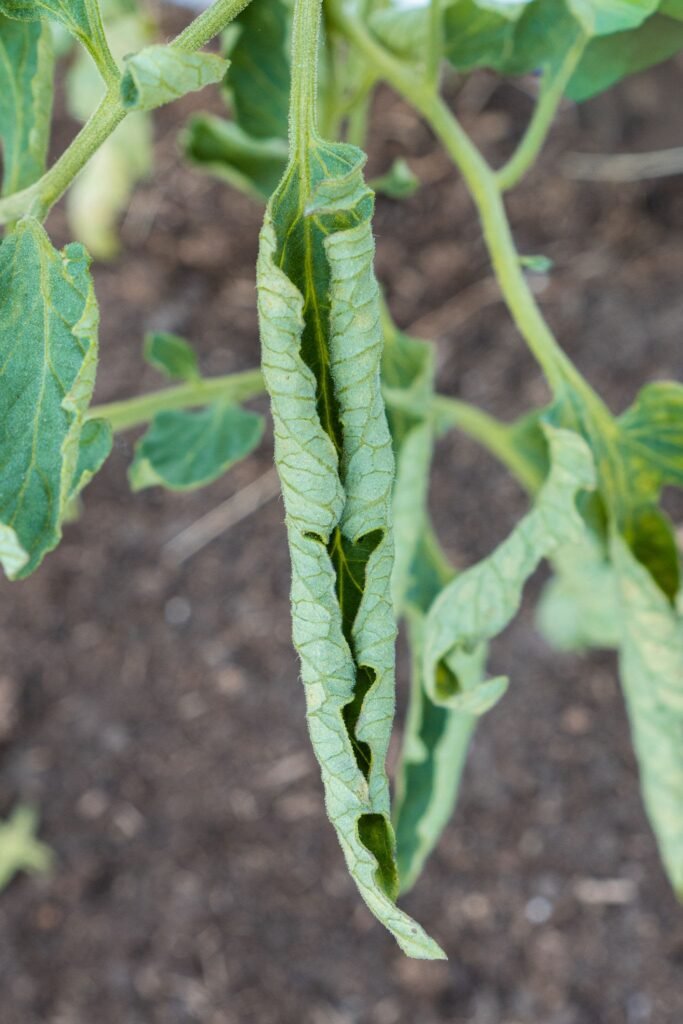
- Color: Deep, uniform green (varying slightly by variety) without interveinal yellowing (chlorosis) or purpling.
- Texture: Soft, pliable, and smooth to the touch. They should yield easily when gently bent, rather than snapping like crisp wafers.
- Posture: Extended horizontally toward sunlight to maximize photosynthesis, with slight drooping only during intense peak midday heat.
- New Growth: Fresh terminal shoots should open up within a day or two rather than remaining tightly bunched together in a rosette shape.
4. Environmental or Physiological Leaf Curl
Physiological leaf roll is a protective reaction rather than a disease. During peak summer months in Central and North India, temperatures regularly cross 38°C–42°C.
When transpiration (water loss through leaves) happens faster than the root system can absorb water from the soil, the plant rolls the edges of its leaves upward and inward toward the central vein. This reduces the surface area exposed to direct sunlight and traps a tiny pocket of humid air beneath the leaf.
How to Identify Physiological Curl:
- Lower Leaves First: It usually starts on the mature, lower leaves near the base of the plant.
- No Discoloration: The leaves remain healthy green without yellow patches or dark spots.
- Firm, Leathery Texture: Rolled leaves feel thick and leathery, but the main stem remains upright and healthy.
- Symmetrical: Both sides of the leaf roll upward evenly.
5. Tomato Leaf Curl Virus Symptoms & Diagnosis
Tomato Leaf Curl Virus (ToLCV) is one of the most destructive plant diseases in India, especially during warm seasons when vector populations soar. Caused by Begomoviruses, this pathogen stops the plant’s vascular system from functioning properly.
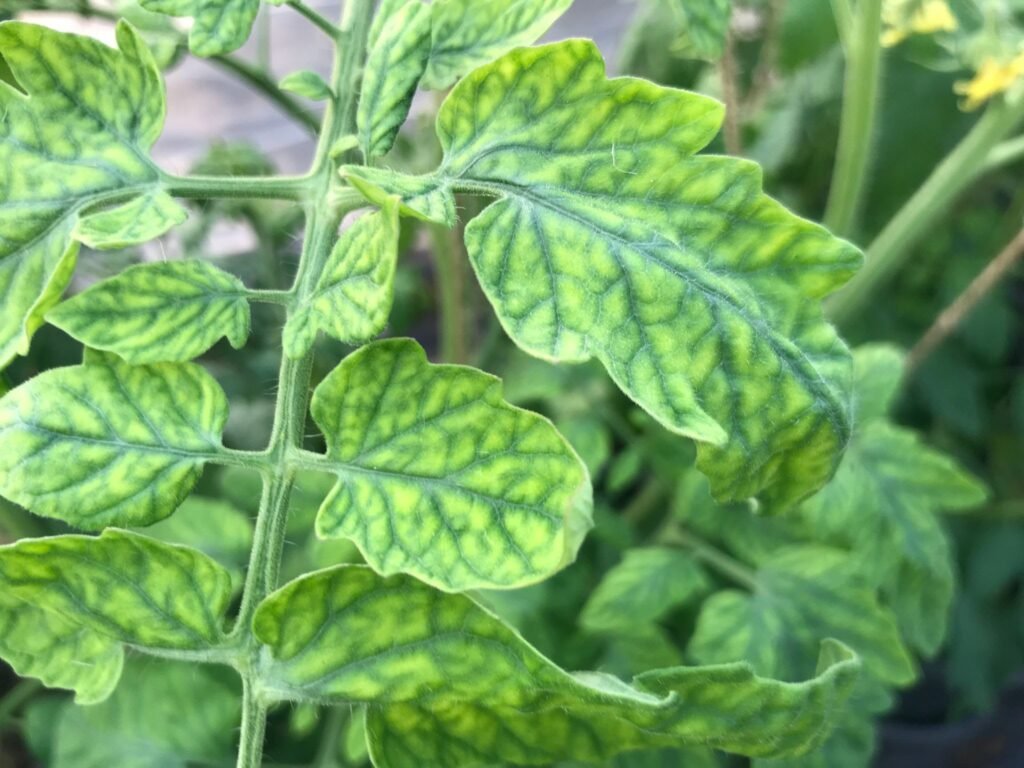
Key Symptoms of Viral Infection:
- Severe Stunting: Growth grinds to a halt. The top shoots become bushy and compressed into a tight “rosette” shape.
- Upward Cupping & Puckering: Leaves curl upward into tight spoon-like cups. Margins turn yellow (chlorosis), while veins may take on a faint purpling on the underside.
- Flower & Fruit Drop: Flowers turn yellow and drop off before fruit set. Any fruit formed before infection remains small, pale, hard, and unmarketable.
- Affects Top Leaves First: Unlike heat stress, viral symptoms appear first on the fresh, young growth at the top of the plant.
6. Whitefly-Related Transmission of Viruses
The virus does not spread by wind or rain splash; it relies almost entirely on an insect vector: the Whitefly (Bemisia tabaci).
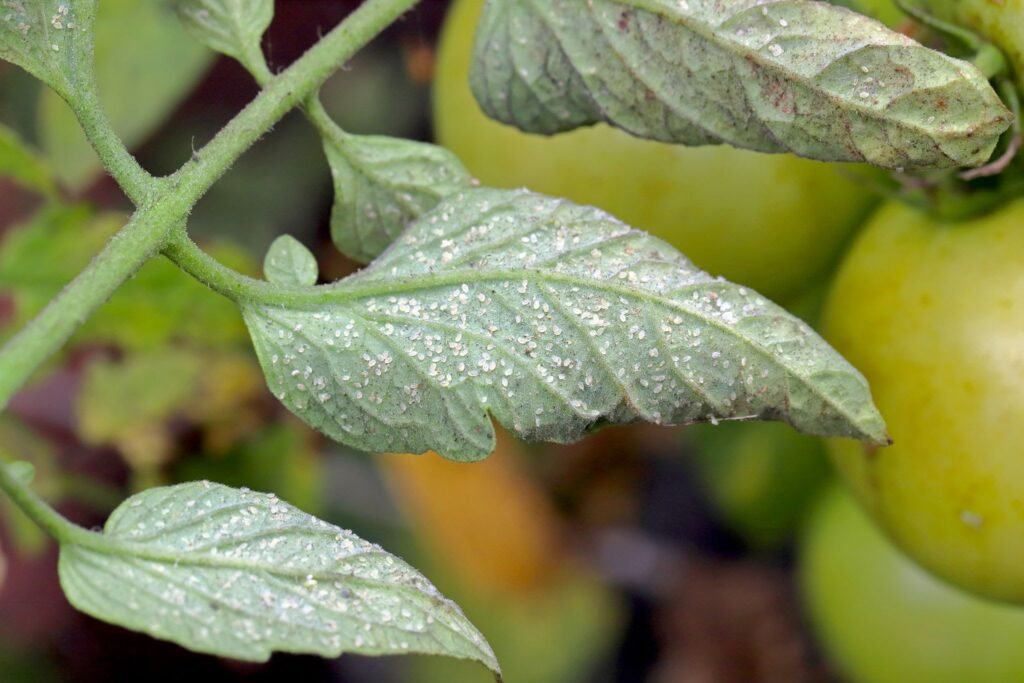
- How Infection Happens: A whitefly feeds on an infected plant or weed, acquiring the virus in as little as 15–30 minutes. When it flies to your healthy tomato plant and pierces the underside of a leaf to feed on sap, it injects the virus into the plant’s phloem.
- Spotting Whiteflies: Gently shake the top branches of your tomato plant in early morning. If tiny, snow-white flies flutter out in small clouds, you have an active whitefly infestation.
- Sooty Mold Secondary Issue: As whiteflies feed, they secrete sticky honeydew on lower leaves, which soon turns black with sooty mold growth.
7. Broad Mites and Other Sucking Pests
Not all pest-induced curling is viral. Broad mites (Polyphagotarsonemus latus) and spider mites thrive during dry Indian summers, causing severe physical distortion that mimics a virus.
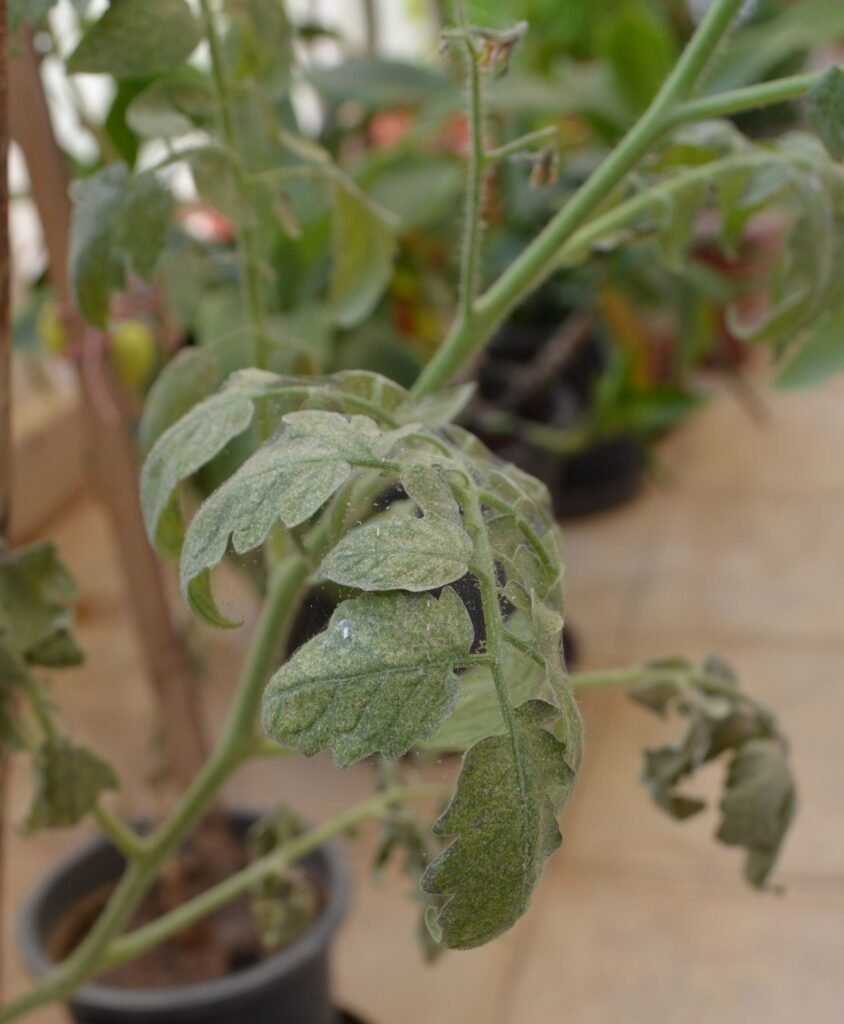
Mites vs. Virus:
- Curling Direction: Mite-damaged leaves often curl downward and inward (clawing), whereas viral infections usually cause upward cupping.
- Underside Sheen: Mites feed on the lower epidermis, giving the undersides of leaves a bronzed, russeted, or shiny metallic appearance.
- Microscopic Size: You cannot easily see broad mites with the naked eye. If new growth turns narrow, stiff, and bronze-colored, suspect mites.
8. Heat, Watering, and Root Stress
Water management is tricky in Indian container gardening and raised beds. Both over-watering and under-watering trigger leaf curling:
- Under-watering & Drought: Leaves turn limp, roll inward, and feel dry or papery. Leaf tips may turn brown and crispy.
- Over-watering & Root Rot: Saturated, waterlogged soil deprives roots of oxygen. Deprived roots cannot pump water to upper branches, so leaves curl upward to cut down transpiration—even while sitting in soggy soil!
- Curled Tomato Leaves in Pots: Potted plants are especially prone to soil temperature spikes. In black plastic pots exposed to direct terrace heat, soil temperatures can top 45°C, frying delicate feeder roots.
9. Can a Curled Tomato Plant Recover?
Whether your tomato plant can recover depends entirely on the root cause:
                  +-----------------------------------+
                  |  Is your tomato leaf curling?     |
                  +-----------------+-----------------+
                                    |
            +-----------------------+-----------------------+
            |                                               |
  [ Environmental / Pests ]                       [ Viral Infection ]
            |                                               |
  - Heat / Drought                                - Tomato Leaf Curl
  - Broad Mite Damage                                 Virus (ToLCV)
  - Over-watering                                           |
            |                                               v
            v                                      +-----------------+
  +-------------------+                            |  NO RECOVERY    |
  |  HIGH RECOVERY    |                            |  REMOVAL        |
  |  POTENTIAL        |                            |  RECOMMENDED    |
  +-------------------+                            +-----------------+
  - Fix watering rhythm                            - Remove plant to
  - Apply 50% shade cloth                            protect neighbors
  - Organic mite control                           - Focus on vector
  - Fresh growth arrives                             control nearby
- Physiological / Heat Stress: 100% Recoverable. Provide shade during peak hours (12 PM to 4 PM), mulch the soil surface, and establish a consistent morning watering schedule. Leaves will unroll or fresh growth will expand normally.
- Mites or Aphids: Highly Recoverable. Once you eliminate the pest population using targeted organic sprays, new shoots will grow out straight and healthy.
- Tomato Leaf Curl Virus: Non-Recoverable. Once a plant is systemically infected with ToLCV, there is no chemical cure or organic wash that can eliminate the virus from its cell structure.
10. What to Do with a Severely Infected Viral Plant
If you confirm that your plant has ToLCV (stunted growth, yellow mosaic leaves, cupping, no fruit set):
- Roguing (Prompt Removal): Carefully uproot the infected plant along with its main root mass. Do not drag it across healthy plants, as whiteflies resting on it will fly off to nearby crops.
- Bag and Dispose: Place the infected plant inside a plastic bag, seal it, and discard it in municipal dry waste. Do not put viral plants into your home compost bin, as warm compost heaps may not completely kill the pathogen or dormant vectors.
- Control Vectors on Remaining Plants: Immediately inspect adjacent tomatoes, chillies, and brinjal (eggplant) for whitefly activity and apply preventive neem oil.
11. Integrated Pest-Management (IPM) & Organic Treatments
To manage leaf curl across your garden without relying on heavy synthetic pesticides, implement a layered Integrated Pest Management (IPM) routine.
Effective Tomato Leaf Curl Organic Treatment Options:
- Yellow Sticky Traps: Hang yellow sticky cards 6 inches above the tomato canopy. Whiteflies are naturally attracted to the bright yellow color and get stuck, breaking their breeding cycle.
- Neem Oil Emulsion (10,000 PPM or Cold-Pressed): Mix 5 mL cold-pressed neem oil + 2 mL liquid dish soap per liter of warm water. Spray thoroughly on leaf undersides every 5–7 days in early morning or late evening.
- Organic Sulfur Spray (for Mites): If broad mites are identified, spray wettable sulfur (2 g/L) or potassium soap on the leaf undersides. Do not apply sulfur when temperatures exceed 32°C to prevent leaf scorch.
- Substrate Mulching: Cover soil surfaces with a 2-inch layer of dry straw, sugarcane bagasse, or dried leaves. Mulch regulates soil temperature and prevents moisture fluctuations.
12. Prevention in Pots, Open Fields, and Protected Cultivation
Prevention is your best defense against tomato leaf curl in Indian growing environments:
┌────────────────────────────────────────────────────────────────────────┐
│                        PREVENTION CHECKLIST                            │
├────────────────────────────────────────────────────────────────────────┤
│ 1. VARIETY SELECT  --> Plant ToLCV-resistant seeds (e.g., Arka Rakshak)│
│ 2. PHYSICAL SHIELD --> Install 40-50% shade cloth or insect netting    │
│ 3. POTTING SOIL    --> Use terracotta/fabric pots with 30% compost     │
│ 4. WEED MANAGEMENT --> Clear Solanaceous weeds (Datura, nightshades)   │
└────────────────────────────────────────────────────────────────────────┘
For Terrace & Container Gardeners (Curled Tomato Leaves in Pots):
- Choose Fabric or Terracotta Containers: Swap out dark plastic pots for breathable fabric grow bags or traditional clay pots to protect roots from overheating.
- Install 50% Green Shade Netting: Shade nets lower ambient canopy temperatures by 4°C–6°C and protect plants from extreme sun scalding.
- Space Out Pots: Ensure adequate air circulation between pots to prevent localized humidity pockets where sucking pests multiply.
For Open Field & Agricultural Beds:
- Grow Resistant Indian Hybrids: Plant ToLCV-tolerant/resistant varieties developed by IIHR or local state agricultural universities, such as Arka Rakshak, Arka Samrat, or Pusa Ruby (selection).
- Border Trapping: Plant barrier rows of French Marigold (Tagetes erecta) or maize around your tomato patch. Marigolds attract beneficial predators and trap whiteflies away from tomatoes.
- Reflective Mulch Sheets: Install silver-on-black polyethylene mulch film. The reflective silver surface disorients flying whiteflies as they look for host plants.
13. Frequently Asked Questions
Q1: Can I use curd or buttermilk spray for tomato leaf curl treatment in India?
Sour buttermilk (khatta chhaas) diluted in water (1:10 ratio) is a popular traditional Indian organic foliar spray. While buttermilk acts as a mild bio-fungicide and leaf fertilizer (providing calcium and lactic bacteria), it cannot cure a viral infection once inside the plant tissue. It can, however, help boost overall plant vigor against mild fungal stress.
Q2: Why are my tomato leaves curling upward in pots during summer?
In balcony or terrace containers, potted soil heats up fast and dries out quickly. Upward leaf rolling in pots is usually physiological heat and moisture stress. Try moving pots to receive morning sun (6 AM–11 AM) while shading them from afternoon sun, and top up with organic mulch.
Q3: How often should I spray neem oil for tomato whiteflies?
For active whitefly populations, spray neem oil emulsion every 4–5 days for three consecutive cycles. For preventive care, spraying once every 10–14 days in early mornings is sufficient.
Q4: Does epsom salt (magnesium sulfate) cure leaf curl?
Epsom salt resolves magnesium deficiency (which causes pale yellowing between green veins on older leaves), but it does not cure viral infections or eliminate sucking pests. Use 1 teaspoon per liter of water as a foliar spray only if magnesium deficiency is confirmed.
See Also
Tomato Leaf Curl 100% control
Tomato Leaf Curl – 3 Causes and Fixes
Yellow Leaves on Curry Leaf Plant? 9 Causes and How to Fix Them
How to Grow Curry Leaf Plant from Cuttings in India: The Right Way to Root Kadi Patta