
Are the leaves of your curry leaf plant turning yellow? Use this simple diagnosis guide to identify over watering, nutrient deficiency, pest damage, winter stress and other common causes.
Yellow leaves on curry leaf plant usually mean that the roots, water, light or temperature are out of balance. The most common reasons are overwatering, poor drainage, dry soil, harsh heat, nutrient deficiency, compacted roots, pests, transplant shock and cold weather.
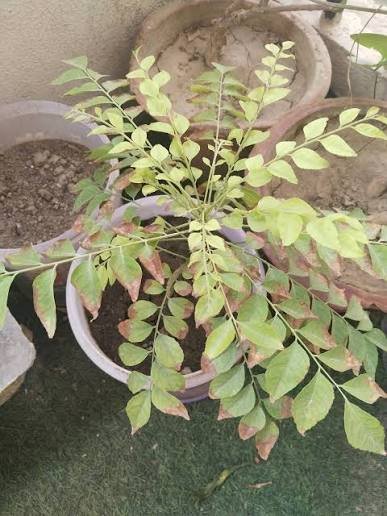
Do not add fertiliser immediately. First check which leaves are yellow, how the soil feels and whether the newest growth is healthy. Once you identify the pattern, most curry leaf plants recover well.
Quick Answer: Why Is My Curry Leaf Plant Turning Yellow?
If you see yellow leaves on curry leaf plant, check the soil first. Wet soil combined with soft, drooping leaves usually points to overwatering. Dry soil and crisp leaf edges suggest underwatering or heat stress.
Yellow lower leaves may simply be old leaves, but widespread yellowing of older foliage can indicate a nitrogen shortage. Pale young leaves with greener veins may mean that iron is present in the soil but unavailable to the plant.
Winter yellowing can also be seasonal. Curry leaf is a warm-climate plant. Tamil Nadu Agricultural University lists 26°C to 37°C as its optimum temperature range and recommends well-drained soil for healthy growth. (Agritech TNAU)
For a quick diagnosis, ask three questions:
- Are the old leaves, new leaves or the entire plant turning yellow?
- Is the soil wet, dry, hard or foul-smelling?
- Can you see webbing, sticky residue, bumps or cotton-like insects?
Yellow Leaves on Curry Leaf Plant: Diagnosis Chart
| What you see | Likely cause | What to do |
|---|---|---|
| One or two lower leaves yellow | Natural ageing | Check whether new growth is green |
| Many lower leaves become pale | Nitrogen shortage | Feed lightly during active growth |
| Yellow leaves with wet soil | Overwatering | Stop watering and improve drainage |
| Soft stem base and heavy leaf fall | Root damage or rot | Inspect roots and repot if necessary |
| Dry, brown leaf edges | Heat, drought or salt stress | Water deeply, flush soil and provide shade |
| Young leaves yellow but veins stay green | Iron unavailable | Check soil alkalinity and root health |
| Older leaves yellow between green veins | Possible magnesium shortage | Confirm the pattern before treating |
| Fine webbing or pale speckles | Spider mites | Treat the undersides of leaves |
| Sticky leaves or white clusters | Scale or mealybugs | Remove pests and repeat treatment |
| Yellowing after repotting | Transplant shock | Keep the plant’s conditions stable |
| Yellowing during cold weather | Winter stress | Reduce watering and protect from cold |
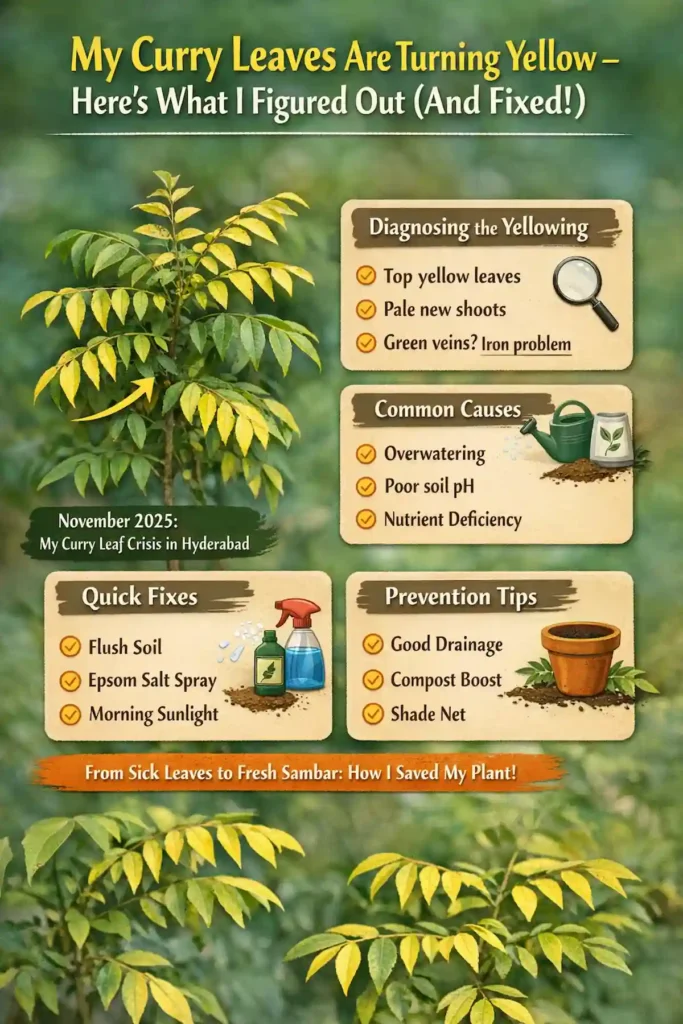
Natural Shedding or a Plant-Health Problem?
Before treating yellow leaves on curry leaf plant, count how many leaves are affected. One or two old lower leaves turning yellow is often normal, especially when the plant is producing healthy green shoots.
Yellow leaves on curry leaf plant are probably natural shedding when:
- Only the oldest leaves are affected.
- New growth is green and opening normally.
- The branches remain green and firm.
- The plant continues growing during warm weather.
Yellowing is more likely to indicate a problem when it spreads quickly, affects young leaves, comes with drooping or causes heavy leaf fall.
Take a clear photograph of the plant and compare it after three days. This makes it easier to judge whether the yellowing is spreading instead of trying several remedies together.
1. Curry Leaf Plant Overwatering and Poor Drainage
Curry leaf plant overwatering is the first cause to rule out, particularly during the Indian monsoon. Roots need oxygen as well as water. When potting soil stays saturated, the roots cannot function properly.
As a result, yellow leaves on curry leaf plant may appear even when the soil contains plenty of nutrients.
Signs of an Overwatered Curry Leaf Plant
- The soil stays wet for several days.
- Leaves are soft, yellow and droopy.
- Leaves fall after a light touch.
- The soil or pot smells sour.
- Roots appear dark and mushy instead of pale and firm.
Stop watering until the upper 4–5 cm of soil feels mostly dry. When the plant needs water again, water it thoroughly and allow all the excess to drain away.
Avoid following a fixed schedule such as “water twice a week.” A pot in Chennai summer will dry very differently from a pot in Mumbai during the monsoon or Delhi in December.
Raise containers on bricks or pot feet during rainy weather. Empty saucers promptly and make sure every drainage hole is open.
Tamil Nadu Agricultural University recommends well-drained soil for curry leaf cultivation. The University of California’s gardening guidance also recommends allowing the soil to dry between watering. (Agritech TNAU)
If yellow leaves on curry leaf plant continue after the soil has dried, gently inspect the roots. Remove only clearly rotten roots and repot the plant in fresh, airy soil. Do not fertilise damaged roots.
2. Underwatering and Indian Summer Heat
Underwatering can also produce yellow leaves on curry leaf plant. However, the leaves generally feel dry, curled or crisp rather than soft.
The pot may feel unusually light, and the soil may pull away from the sides of the container. Water may also rush straight through severely dry soil without properly moistening the root ball.
West-facing balconies in Delhi, Jaipur, Ahmedabad, Hyderabad and Nagpur can become extremely hot because walls, glass and tiles reflect heat. Curry leaf plants enjoy warmth and sunlight, but their roots can still overheat inside small black plastic pots.
To correct yellow leaves on curry leaf plant caused by heat stress:
- Water slowly until the entire root ball is moist.
- Water again after ten minutes if the dry soil initially repels water.
- Add a thin layer of dry-leaf mulch or coco chips.
- Keep mulch away from the main stem.
- Protect the plant from severe afternoon sun during a heatwave.
- Place a black nursery pot inside a larger, thicker container.
Do not move a plant directly from deep shade into full May sunlight. Increase its sun exposure gradually over seven to ten days.
3. Too Little Sunlight and Pale Growth
Yellow leaves on curry leaf plant can also develop in deep shade, where growth becomes thin, weak and pale.
Low light creates an additional problem: the soil dries slowly. The gardener may continue watering at the usual frequency, accidentally creating overwatering and root stress.
Low-light yellow leaves on curry leaf plant usually appear alongside:
- Thin or stretched stems
- Large spaces between leaves
- Very slow growth
- Small or weak new shoots
- Soil that remains damp for too long
Move the plant gradually to a brighter location. Morning sunlight is particularly helpful for a stressed or recently repotted curry leaf plant.
Once the plant adjusts, it can receive stronger sunlight. Tender new leaves should still be protected from a sudden shift into severe afternoon heat.
4. Curry Leaf Plant Nutrient Deficiency
A curry leaf plant nutrient deficiency should be diagnosed from the pattern of yellowing. Do not add compost, Epsom salt, iron tonic and liquid fertiliser all at once.
Different nutrients move differently inside a plant. The age and location of the yellow leaves therefore provide useful diagnostic clues.
Nitrogen Deficiency: Older Leaves Yellow First
Nitrogen shortage normally causes uniform yellowing of older lower leaves. The plant moves its available nitrogen towards new growth, leaving the oldest foliage pale.
University of Minnesota Extension also identifies yellowing of older, lower leaves as a typical nitrogen-deficiency pattern. (Extension at the University of Minnesota)
If the roots are healthy and the plant is actively growing, apply one of the following:
- A thin layer of mature compost
- Well-decomposed vermicompost
- A diluted balanced fertiliser used according to its label
More fertiliser will not produce faster recovery. Excess fertiliser can burn the roots and worsen yellow leaves on curry leaf plant.
Iron Deficiency: Young Leaves Yellow Between Green Veins
Iron chlorosis normally affects young leaves first. The tissue between the veins becomes pale yellow while the veins remain noticeably greener.
This does not always mean that the soil contains no iron. Alkaline potting soil, repeated wood-ash applications or hard water can make existing iron difficult for roots to absorb. Interveinal yellowing is a recognised symptom of iron chlorosis. (Extension at the University of Minnesota)
Avoid repeatedly adding lime or wood ash around the plant. Replace part of the tired potting mix with fresh soil and compost.
Use a properly labelled chelated-iron product only when the appearance of the leaves supports an iron problem.
Magnesium Deficiency: Older Leaves Retain Green Veins
Magnesium deficiency generally begins on older leaves. The areas between the veins become yellow, while the veins may remain green. Advanced cases can develop small brown or dead patches. (Extension at the University of Minnesota)
Epsom salt is not a universal cure for yellow leaves on curry leaf plant. Adding magnesium when the soil already contains enough can disturb the uptake of other nutrients. Strong Epsom-salt sprays may also scorch the leaves. (Extension at the University of Minnesota)
Correct watering and drainage before attempting to treat a suspected magnesium shortage.
5. When Yellow Leaves on Curry Leaf Plant Mean It Is Root-Bound
Sometimes yellow leaves on curry leaf plant appear because the roots have filled the container or the soil has become hard, compacted and airless.
Signs of a Root-Bound Curry Leaf Plant
- Roots are circling through the drainage holes.
- Water sits on the surface before entering the soil.
- The plant wilts soon after watering.
- Growth remains slow despite warm weather.
- The plant has become top-heavy and keeps tipping over.
To correct yellow leaves on curry leaf plant caused by tight roots, repot during warm, active-growing weather.
Choose a new pot only 5–8 cm wider than the existing root ball. Placing a small plant in a very large container creates a thick layer of unused soil that may remain wet for too long.
A practical Indian container mix may contain:
- Garden soil
- Mature compost or vermicompost
- Coarse river sand, perlite or processed rice husk
The exact ingredients can vary. The important point is that the mix must hold some moisture without remaining waterlogged.
If only the surface is hard, replace the upper few centimetres of soil rather than disturbing the entire root system.
6. Spider Mites, Scale and Mealybugs
Sap-sucking pests can also cause yellow leaves on curry leaf plant. Inspect the undersides of leaves, tender shoots and branch joints in bright daylight.
Spider Mites
Look for:
- Fine webbing
- Dusty-looking foliage
- Tiny pale dots or speckles
- Leaves gradually becoming dull and yellow
Spider mites multiply quickly during hot, dry and dusty weather.
Scale Insects
Scale insects resemble small brown, grey or whitish bumps attached to stems and leaf veins. The leaves may become sticky because the insects release honeydew.
Mealybugs
Mealybugs form white, cotton-like clusters around leaf joints, nodes and young shoots.
When pests are causing yellow leaves on curry leaf plant, isolate the affected pot from your other plants.
Wash the foliage gently, paying particular attention to the undersides. Remove visible scale insects and mealybugs with a cotton bud dipped in mild soapy water.
Follow with a labelled insecticidal soap or neem-based horticultural product. Test it on a small section first. Spray during the cool evening rather than under strong sunlight and repeat the treatment according to the product label.
One application rarely removes every stage of a pest infestation.
7. Transplant and Environmental Shock
Repotting, nursery transport, root disturbance or a sudden change in sunlight may cause yellow leaves on curry leaf plant.
After repotting, disturbed roots may temporarily be unable to replace all the water being lost through the leaves.
Keep the plant in bright but gentle light for several days. Maintain lightly moist—but never soggy—soil. Avoid strong fertiliser until healthy new growth appears.
Do not repeatedly shift the pot while it is recovering. Stability is part of the treatment.
A newly purchased nursery plant may have been grown under shade netting. Gradually acclimatise it to direct sunlight instead of immediately placing it on an exposed terrace.
8. Yellow Leaves on Curry Leaf Plant from Salt and Hard Water
Yellow leaf margins, brown tips and a white crust on the soil or pot rim may indicate salt accumulation.
This is common when a small container receives frequent liquid fertiliser, multiple kitchen remedies or hard borewell water.
Flush the pot by running plenty of plain water through the soil. Allow the water to drain completely. Do not leave the container standing in the flushed water.
Pause all fertiliser applications until healthy new growth appears.
If yellow leaves on curry leaf plant developed shortly after feeding, fertiliser salt stress is more likely than a sudden nutrient deficiency.
9. Why Curry Leaves Turn Yellow in Winter
Curry leaves yellow in winter because this tropical plant slows down when temperatures and daylight fall.
In Delhi, Chandigarh, Lucknow, Jaipur and other cooler Indian cities, cold nights and dry winds can cause yellowing followed by partial leaf loss. Curry leaf plants can remain evergreen in warm conditions but may shed leaves in colder microclimates. (UC Agriculture and Natural Resources)
Winter yellow leaves on curry leaf plant are generally seasonal when the branches remain green and firm. The condition is more concerning when the soil stays wet, the base of the stem becomes dark or the branches become dry and brittle.
Curry Leaf Plant Winter Care
- Place the pot in the sunniest sheltered location available.
- Protect it from frost and cold wind.
- Water less frequently because the soil dries slowly.
- Stop heavy feeding when active growth pauses.
- Avoid major pruning during a cold spell.
- Postpone non-essential repotting until warmer weather.
Do not increase watering simply because the leaves are falling. Doing so can turn manageable cold stress into root rot.
Seven-Step Recovery Plan for Yellow Leaves on Curry Leaf Plant
Follow these steps in order when the exact cause is unclear.
1. Check the Soil Moisture
Test the soil several centimetres below the surface. Inspect the drainage holes and make sure the pot is not standing in water.
2. Study the Yellowing Pattern
Note whether the old leaves, young leaves, leaf margins or areas between the veins are affected.
3. Inspect for Pests
Check leaf undersides, branch joints and young shoots for webbing, bumps, stickiness or cotton-like insects.
4. Stabilise the Location
Provide bright light, airflow and protection from severe afternoon heat or cold wind. Avoid repeatedly moving the plant.
5. Correct the Watering Routine
Water deeply only when the upper soil has partly dried. Make sure excess water escapes freely.
6. Feed After Growth Restarts
Once fresh shoots appear, apply compost or a mild balanced feed. Avoid feeding a plant with waterlogged or damaged roots.
7. Judge the New Growth
Fully yellow leaves rarely become green again. The real sign of recovery is a fresh flush of healthy green leaves.
Remove completely yellow or dry foliage using clean scissors. Do not strip every partly green leaf because it can still help the plant produce energy.
When to Repot and When to Fertilise
Repot the Plant When:
- Water cannot pass through the root ball.
- Roots tightly circle the pot.
- The potting mix smells foul.
- Roots are dark and mushy.
- The container has inadequate drainage.
Wait Before Repotting When:
- The plant is shedding only a few winter leaves.
- It was recently repotted.
- It is severely dehydrated.
- The weather is extremely hot or cold.
Fertilise the Plant When:
- It is actively producing new growth.
- The roots and drainage are healthy.
- Older leaves display a consistent nutrient-deficiency pattern.
- The plant has remained in the same potting mix for many months.
Do not fertilise yellow leaves on curry leaf plant when the soil is waterlogged, the roots are damaged, the plant has just been transplanted or winter growth has stopped.
Frequently Asked Questions
Can Yellow Leaves on Curry Leaf Plant Turn Green Again?
Partly pale leaves may improve when a minor problem is corrected. Fully yellow leaves usually remain yellow. Judge the plant’s recovery by the next flush of growth.
Should I Remove Yellow Leaves on Curry Leaf Plant?
Remove leaves that are fully yellow, dry or heavily infested with pests. Keep partly green leaves unless they are diseased because they can still produce energy for the plant.
How Often Should I Water a Curry Leaf Plant?
Water when the upper 4–5 cm of soil feels mostly dry. Soak the entire root ball and let the excess drain.
The frequency will change according to the weather, pot size, wind, soil composition and location. Curry leaf plants need more frequent watering during hot, dry weather and much less during cold or humid conditions.
Why Is My Curry Leaf Plant Turning Yellow After Repotting?
The most likely causes are transplant shock, disturbed roots or a sudden change in sunlight.
Keep the plant in stable conditions and avoid strong fertiliser until it begins producing healthy new leaves.
What Does Curry Leaf Plant Overwatering Look Like?
The soil remains damp while the leaves become soft, yellow and droopy. Severe cases may have a sour smell, rapid leaf fall and dark, mushy roots.
How Do I Identify Curry Leaf Plant Nutrient Deficiency?
Uniform yellowing of older leaves may suggest a nitrogen shortage. Yellow young leaves with green veins may indicate poor iron availability. Yellowing between the veins of older leaves may suggest magnesium deficiency.
Always correct watering and drainage before assuming that the plant needs fertiliser.
Why Are Yellow Leaves on Curry Leaf Plant Common in Winter?
Curry leaves yellow in winter because low temperatures slow the plant’s growth and may trigger seasonal leaf fall.
Reduce watering, provide as much sunlight as possible and protect the plant from cold wind. Avoid forcing new growth with strong fertiliser.
Is Epsom Salt Good for Yellow Curry Leaves?
Only when magnesium deficiency is genuinely likely. Epsom salt is not a universal treatment for yellow leaves on curry leaf plant.
Using it unnecessarily can disturb the nutrient balance of the soil or scorch leaves when applied in a concentrated spray.
What Is the Quickest Fix for Yellow Leaves on Curry Leaf Plant?
Check the roots and soil first. Correct moisture and drainage, provide suitable light, treat visible pests and fertilise only after healthy growth begins.
Avoid applying several treatments at the same time.
Final Takeaway
Yellow leaves on curry leaf plant are a symptom, not a diagnosis. Wet soil suggests overwatering, while dry and crisp edges suggest heat or drought. Patterned yellowing may indicate a nutrient-availability problem, speckled leaves may point to pests and winter leaf fall usually indicates cold stress.
Fix the root environment first and avoid combining remedies. Keep the plant bright, warm and well drained, and then watch the next set of leaves.
In most cases, a curry leaf plant turning yellow can recover once the real cause is identified and corrected.
See Also
My Curry Leaves Are Turning Yellow
Yellow leaf plants nutrient deficiency diagnosis
How to Grow Curry Leaf Plant from Cuttings in India: The Right Way to Root Kadi Patta
How to Grow Methi in Pots at Home in India: The Ultimate 20-Day Fenugreek Leaves Guide