
Thinking about setting up protected cultivation on your farm but confused between a shade net house vs polyhouse in India installation? You are not alone. Every progressive farmer, agri-entrepreneur, and farm investor looking to step into high-yield horticulture hits this exact fork in the road.
Installing protected cultivation is a major farm infrastructure investment. Choosing the wrong structure means either overspending on high-tech tech you don’t need, or watching your crops suffer because your shade net couldn’t handle heavy monsoon rains.
In this comprehensive guide for gardenfresh-india.com, we break down capital requirements, environmental controls, pest exclusion, suitable crops, government subsidies, and real-world running costs so you can make a profitable commercial decision.
1. Quick Answer: Who Should Choose Each Structure?
Before diving into detailed economics, here is the short verdict:
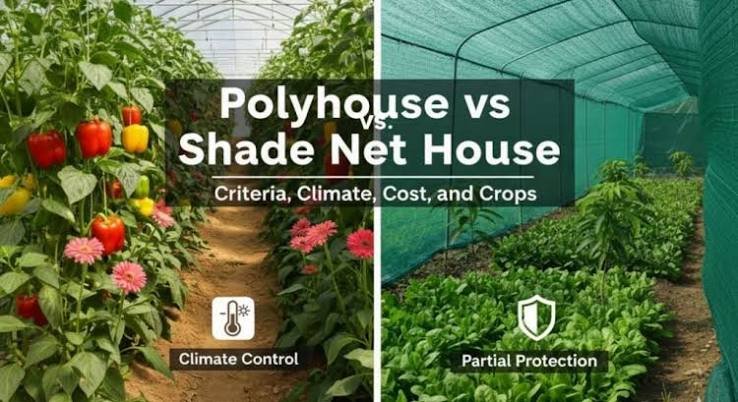
- Choose a Shade Net House if: You are growing nurseries, leafy greens, flower propagation, or shade-loving crops; your region faces extreme summer heat without heavy rain hazards; and your primary goal is temperature reduction and light control with a lower initial setup budget.
- Choose a Naturally Ventilated Polyhouse if: You are targeting high-value commercial vegetables like seedless colored capsicum (bell pepper), parthenocarpic cucumber, cherry tomatoes, or cut flowers (Dutch roses, gerbera); you need year-round protection from unseasonal rains, wind, hail, and heavy pest pressures; and you have moderate to high capital to invest.
- Choose a Climate-Controlled Greenhouse if: You are producing ultra-premium niche crops (such as exotic orchids, high-grade tissue culture plants, or year-round export-grade produce) where exact microclimate control is mandatory regardless of ambient weather, and you have robust capital and uninterrupted electricity supply.
2. Shade Net versus Polyhouse Comparison Table
| Factor | Shade Net House | Naturally Ventilated Polyhouse | Climate-Controlled Greenhouse |
| Environmental Control | Limited (light reduction & micro-cooling) | Moderate (rain protection & natural air flow) | High (automated temperature & humidity) |
| Initial Investment | Lower (₹350 – ₹700 / sq m) | Medium–High (₹800 – ₹1,000 / sq m) | Highest (₹1,600 – ₹2,500 / sq m) |
| Suitable Crops | Nursery, leafy crops, ornamentals | Vegetables, flowers, nursery crops | High-value specialised crops |
| Pest Exclusion | Partial (blocks birds/large insects; thrips enter) | Better when properly sealed with insect net | High but management-intensive |
| Rain Protection | No (rain passes straight through) | 100% Waterproof UV-film cladding | 100% Waterproof UV-film cladding |
| Power Dependency | Zero to minimal (drip pumps only) | Low to moderate (foggers & drip) | Heavy (24/7 continuous electricity required) |
3. How a Shade Net House Works
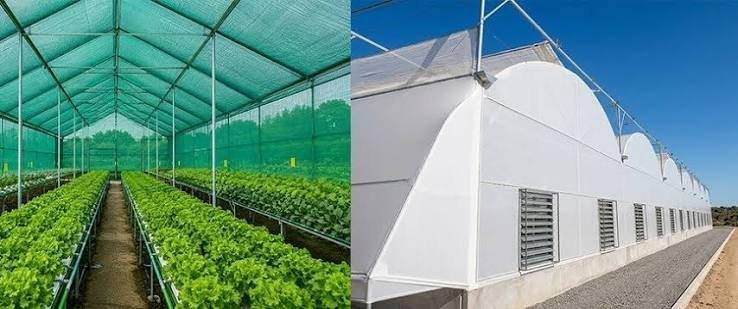
A shade net house is an open-air structural framework built using GI pipes or steel cables, wrapped entirely with woven or knitted synthetic polyethylene netting.
Light Regulation and Cooling
The primary job of a shade net is to diffuse harsh direct sunlight and cut down heat radiation. Nets come in specific shading factors (typically 15%, 35%, 50%, 75%, and 90%).
- 35% – 50% shading: Ideal for commercial vegetable production like capsicum and tomato in moderate regions.
- 75% shading: Designed for plant nurseries, leafy greens, and shade-loving ornamentals.
Wind and Physical Shielding
While air moves freely through the mesh, the net acts as a windbreak, guarding fragile young seedlings against physical damage caused by strong surface winds and minor hail. However, water passes right through; it offers no protection against heavy rain downpours.
4. How a Naturally Ventilated Polyhouse Works
A naturally ventilated polyhouse (NVPH) is the gold standard for commercial farming across 70% of Indian protected cultivation setups.
UV-Stabilized Polyethylene Cladding
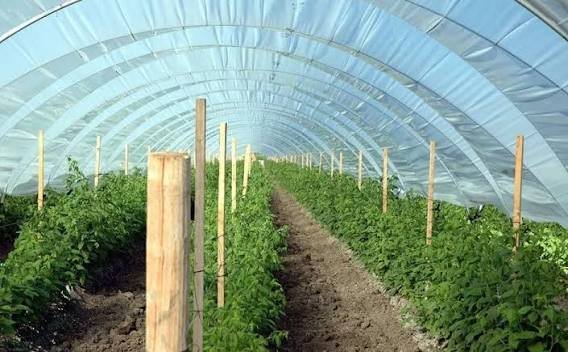
Instead of net fabric, the roof and sides are wrapped in 200-micron, 5-layer anti-drip, anti-fog UV-stabilized plastic film. This clear film creates a controlled mini-atmosphere inside, retaining heat during cool nights while keeping rain and external humidity surges off the crop.
Thermal Draft Venting
NVPH structures feature top ridge vents and side skirt openings covered with 40 or 50-mesh insect netting. Hot air naturally rises and escapes through the top ridge vent, drawing cooler fresh air in through the side vents. This continuous thermal draft prevents heat buildup during warm days without requiring heavy electric exhaust fans.
5. Climate-Controlled Greenhouse Basics
When naturally ventilated polyhouses cannot handle intense summer temperatures (such as 42°C+ heatwaves in Rajasthan or Central India), growers upgrade to climate-controlled (Fan and Pad) greenhouses.
Fan and Pad Cooling Mechanics
One side of the structure holds thick cellulose cooling pads continuously soaked with water, while the opposite wall houses massive industrial exhaust fans. The fans pull air through the wet pads, cooling the ambient air temperature inside by 8°C to 12°C via evaporative cooling.
Higher Operational Overhead
While fan and pad systems deliver precision control over temperature and relative humidity, they require substantial capital. They also need backup diesel generators to ensure power is never lost; stopping exhaust fans during peak summer heat can destroy a crop within hours.
6. Suitable Crops for Each Structure
Selecting between polyhouse or shade house setups depends directly on what you intend to harvest:
Recommended Shade Net House Crops
- Plant Nurseries: Vegetable seedlings (tomato, chili, onion), fruit plant grafting, and sapling propagation.
- Leafy Greens: Spinach, lettuce, celery, coriander, and mint.
- Shade-Loving Crops: Vanilla, cardamom, ginger, turmeric, and medicinal herbs.
- Ornamentals: Ferns, orchids, indoor foliage plants, and anthuriums.
Recommended Polyhouse Crops
- High-Value Fruiting Vegetables: Red, yellow, and green capsicum, seedless English cucumbers, cherry tomatoes, and vine tomatoes.
- Exotic Vegetables: Zucchini, broccoli, and colored peppers.
- Commercial Cut Flowers: Dutch roses, gerberas, carnations, liliums, and chrysanthemums.
- Fruits: High-density strawberries.
7. Cost Components—Not Only the Structure Price
Evaluating shade net house cost India against polyhouse rates requires analyzing total project expenditures, not just frame prices.
Capital Cost Breakdown (Per Acre / ~4,000 sq m Basis)
- Shade Net House Setup: ₹14 Lakhs to ₹28 Lakhs total investment (depending on single-layer cable purlin vs double-layer GI pipe purlin structure).
- Naturally Ventilated Polyhouse: ₹32 Lakhs to ₹40 Lakhs total project investment.
- Fan & Pad Polyhouse: ₹60 Lakhs to ₹75+ Lakhs total investment.
Cost Distribution (GI Pipe Net House Project)
├── GI Frame & Structural Pipes : 35%
├── Foundation & Site Labour   : 25%
├── UV Netting / Poly Cladding : 22%
├── Drip & Fertigation System  : 12%
└── Site Prep & Contingency    : 6%
Hidden and Additional Cost Factors
- Land Levelling & Civil Base: Grading slope, concrete footings, and boundary trenching.
- Water Infrastructure: Digging borewells, installing storage farm ponds, and setting up filtration units.
- Trellising Systems: GI support wires, polypropylene twines, and hooks for climbing crops like cucumber and capsicum.
- Working Capital: Seeds/seedlings, media (cocopeat), fertilizers, labor, and packaging boxes for season one.
8. Irrigation, Ventilation and Power Requirements
| Parameter | Shade Net House | Polyhouse (NVPH) | Climate-Controlled |
| Irrigation Method | Drip lines & overhead mini-sprinklers | Drip lines & high-pressure foggers | Drip/hydroponics & misting |
| Water Requirement | Moderate (higher evaporation via open mesh) | Optimised (minimal surface evaporation) | Moderate-High (pad consumption) |
| Ventilation Mode | 100% natural side/top air movement | Natural thermal stack draft | Forced mechanical exhaust fans |
| Electricity Load | 3 to 5 HP pump power | 5 to 7.5 HP (drip + fogger pump) | 15 to 30+ HP plus Genset backup |
9. Pest and Disease Risks
In the shade net vs polyhouse India decision, micro-climate control drives crop health and pest pressure:
Pest Control in Shade Net Houses
- Strengths: Excellent protection against large insects, caterpillars, beetles, birds, and monkeys.
- Weaknesses: Micro-pests like thrips, whiteflies, red spider mites, and aphids can easily enter standard netting. Because rain falls inside, leaves stay wet longer, increasing fungal leaf spot risks during rainy seasons.
Pest Control in Polyhouses
- Strengths: Sealed side walls equipped with 40/50-mesh anti-insect nets keep out major vector pests. Rainwater is kept off the foliage, reducing fungal bacterial blights and downy mildew risks.
- Weaknesses: If thrips or mites bypass entry protocols and colonize inside, the warm shelter allows their population to explode rapidly. Entry chambers with double-door locks are mandatory.
10. Decision Guide by Climate
Your geographic location in India plays a massive role in choosing your protective structure:
- Heavy Monsoon Belts (Western Ghats, Konkan, Kerala, Northeast, Coastal Odisha): Polyhouse is mandatory. Uncontrolled rain under a shade net causes soil waterlogging, root rot, and blossom drops.
- Dry Hot Plains (Rajasthan, Marathwada, Parts of MP & Gujarat): Shade nets with 50% shading or fan-and-pad polyhouses work best. Standard polyhouses can overheat during May-June heatwaves unless equipped with shade screens and foggers.
- Mild Temperate Plateaus (Bengaluru, Pune, Nashik, Himachal foothills): Both NVPH and shade nets thrive. Polyhouses in these regions produce premium yields of export capsicum and cut flowers.
11. Decision Guide by Crop and Budget
Match your financial situation with your target crop requirements:
                       [Determine Your Capital Budget]
                                      │
               ┌──────────────────────┴──────────────────────┐
               ▼                                             ▼
     [Capital: ₹15 - 20 Lakhs/Acre]              [Capital: ₹35 - 45+ Lakhs/Acre]
               │                                             │
      (Shade Net Structure)                         (Polyhouse Structure)
               │                                             │
       Target Crop Choice                            Target Crop Choice
  ┌────────────┴────────────┐                  ┌─────────────┴─────────────┐
  ▼                         ▼                  ▼                           ▼
[Nursery/Leafy]     [Local Vegetables]  [Colored Capsicum]       [Dutch Roses/Gerbera]
12. Questions to Ask an Installer
Before signing a contract or handing over an advance, ask your vendor these key questions:
- Steel Quality: Are structural members made of hot-dip Galvanized Iron (GI) pipes with a minimum zinc coating of 275 gsm?
- Wind Rating: What maximum wind velocity (e.g., 110 km/h or 140 km/h) is the structural engineering certified to withstand?
- Cladding Guarantee: Does the 200-micron polyfilm or UV net come with a written 3 to 5-year manufacturer warranty against degradation?
- Fastening Hardware: Are locking springs (zigzag wire) and aluminum profile channels anodized to prevent rust?
- Subsidy Compliance: Is your structure design pre-approved by the State Horticulture Mission / National Horticulture Board guidelines?
13. Government Subsidy Checklist
Securing a protected cultivation subsidy India grant significantly lowers capital risk.
Available Schemes
- Mission for Integrated Development of Horticulture (MIDH): Administered via State Horticulture Missions (SHM) for project sizes under 4,000 sq m (1 acre).
- National Horticulture Board (NHB): Directly supports commercial projects larger than 4,000 sq m.
Subsidy Percentage and Assistance Norms
- Polyhouses and shade net structures receive up to a 50% subsidy on standard cost norms.
- Polyhouse standard benchmark norm: ~₹1,000 / sq m.
- Shade net house standard benchmark norm: ~₹710 / sq m.
- Hilly, tribal, and North-Eastern regions receive higher subsidy assistance rates (up to 85–90% in select state schemes).
14. How to Verify Current State and National Scheme Conditions
Subsidy rules and funds fluctuate across financial years. Follow these steps to verify eligibility:
- Visit the official portal of NHB (nhb.gov.in) or your State Horticulture Mission website.
- Meet your District Horticulture Officer (DHO) to confirm current fund availability.
- Ensure your land title (7/12 extract or long-term lease agreement) is registered and clear.
- Apply online and secure a Letter of Intent (LOI) or Administrative Approval BEFORE starting civil work on-site. Starting construction prior to LOI issuance forfeits subsidy eligibility.
15. Inputs Required for an ROI Calculation
When drafting your Detailed Project Report (DPR) for bank loan approvals, include these inputs:
- Fixed Capital Costs: Frame fabrication, net/polyfilm, drip fertigation unit, civil foundation, electrical connections, and labor.
- Operational Expenses (OpEx per crop cycle): Planting material (hybrids/grafted seedlings), growing media, water soluble fertilizers (WSF), crop protection chemicals, labor, trellising twine, and packing crates.
- Yield Projections: Use realistic regional figures (e.g., 30–40 tonnes/acre for polyhouse capsicum) rather than maximum vendor claims.
- Payback Period: Most well-managed polyhouse and shade net projects achieve capital recovery within 1.5 to 3 years post-subsidy disbursement.
16. Common Protected-Cultivation Mistakes
Avoid these common traps to protect your investment:
- Skipping the Double-Door Chamber: Omitting the entry chamber to cut costs allows pests free access every time workers walk inside.
- Cheaper Non-UV Netting: Buying non-UV stabilized plastic or shade netting causes material to degrade, tear, and crumble within 12 months under heat.
- Poor Site Orientation: Constructing the roof orientation without checking east-west sun direction or local prevailing wind patterns leads to structural strain or improper light penetration.
- Exhausting Working Capital: Spending 100% of available funds on steel and polyfilm, leaving insufficient cash for high-quality seeds, fertilizers, and labor.
17. Frequently Asked Questions
Which is cheaper, a polyhouse or a shade net house?
A shade net house is significantly cheaper. It costs between ₹350 and ₹700 per sq m, while a naturally ventilated polyhouse costs between ₹800 and ₹1,000 per sq m.
Can I grow capsicum in a shade net house?
Yes, you can grow green capsicum in a shade net house during dry seasons. However, for premium seedless colored capsicum (red and yellow), a polyhouse is recommended to protect fruits from rain spots, sunburn, and pest damage.
How long does polyfilm and shade net material last?
High-quality, 200-micron UV-stabilized polyfilm and 50-mesh UV shade nets typically last 3 to 5 years. The underlying GI steel frame lasts over 15 to 20 years with minor maintenance.
Is bank loan approval mandatory for polyhouse subsidies in India?
Yes. Most government subsidy programs under NHB and MIDH are credit-linked back-ended subsidies, requiring an approved term loan from a recognized bank.
See Also
- Shade Net House vs Polyhouse: Which Structure Is Best for Your Farm?
- How to Choose Between Polyhouse vs Shade Net House for Your Farm: Criteria, Climate, Cost, and Crops
- The Protected Cultivation Blueprint: The Ultimate Polyhouse Vegetable Farming Guide India
- High-Density Guava Farming in India: Spacing, Pruning, Yield and Profit Guide
- The Kamalam Revolution: The Ultimate Guide to Dragon Fruit Farming in India