
Step into any modern Indian supermarket, premium fruit stall, or local sabzi mandi, and you are bound to see a striking, bright pink fruit with distinct green scales looking right back at you. Not too long ago, dragon fruit—now officially rebranded as Kamalam by the Government of India due to its lotus-like appearance—was viewed as a premium, exotic luxury imported from Southeast Asia. So, what is the best climate for growing dragon fruit in India.
Today, the landscape has changed completely. Indian farmers across Maharashtra, Gujarat, Karnataka, Andhra Pradesh, Telangana, and Rajasthan are shifting away from traditional water-intensive crops like sugarcane and paddy to clear room for this vibrant cactus.
Why? Because dragon fruit has become the hottest high-margin, climate-resilient crop in the Indian agricultural sector. With low water requirements, minimal recurring maintenance costs, and a high market price, it offers an incredible opportunity for agri-entrepreneurs and forward-thinking farmers.
However, moving into commercial cultivation requires a solid understanding of how this desert-native plant operates. If you want to build a highly profitable plantation, you must master the fundamental environment it requires. Let’s look into the best climate for growing dragon fruit in India, explore the required structural investments, and analyze the long-term commercial viability of this remarkable crop.
Agro-Climatic Needs: The Environment for Growing Kamalam
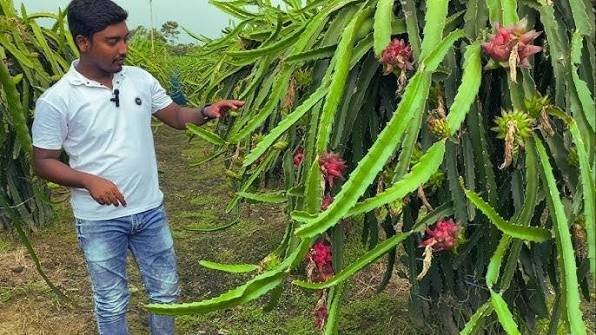
Despite its exotic look, dragon fruit is fundamentally a tropical cactus belonging to the Hylocereus family. This means it is incredibly tough, highly drought-tolerant, and perfectly suited for India’s changing weather patterns. However, if you want your plants to yield massive, juicy fruits that fetch premium market prices, you must align your plantation with its ideal environmental sweet spot.
+-------------------------------------------------------------+
|                 DRAGON FRUIT CLIMATIC COMFORT ZONE          |
+-------------------------------------------------------------+
|  Ideal Temperature Range  |  $20^\circ\text{C}$ to $40^\circ\text{C}$              |
|  Annual Rainfall Need     |  $500\,\text{mm}$ to $1500\,\text{mm}$             |
|  Sunlight Requirement     |  Full, open, unshaded fields    |
+-------------------------------------------------------------+
1. Temperature Parameters: Balancing Heat and Frost
When determining the best climate for growing dragon fruit in India, temperature is your single most important metric. The plant thrives comfortably in areas where the ambient temperature hovers between $20^\circ\text{C}$ and $40^\circ\text{C}$.
- The Extreme Heat Challenge: While it is a cactus, extreme heat can be problematic. If your region experiences intense summer spikes crossing $40^\circ\text{C}$ to $45^\circ\text{C}$ (common in parts of Central and Northern India), the intense sun can scorch the green stems, turning them yellow and causing flower buds to drop. Farmers in these zones often use light shade nets or apply organic anti-transpirant sprays during May.
- The Frost Threat: On the flip side, the plant hates extreme cold. If temperatures drop below $10^\circ\text{C}$ or approach freezing, the plant suffers severe tissue damage and growth stops completely. This makes coastal, central, and southern peninsula regions structurally ideal for open-field cultivation.
2. Low Rainfall and Sunny Open Fields
Unlike traditional Indian crops that require flooded fields, dragon fruit is highly water-efficient. It thrives in regions with low to moderate annual rainfall, ideally between $500\,\text{mm}$ and $1500\,\text{mm}$.
The plant requires a fully open, unshaded field. It needs direct sunlight to trigger flowering. Shady locations or planting dragon fruit under the canopy of large mango or coconut trees will result in beautiful, long green vines that produce absolutely zero fruit.
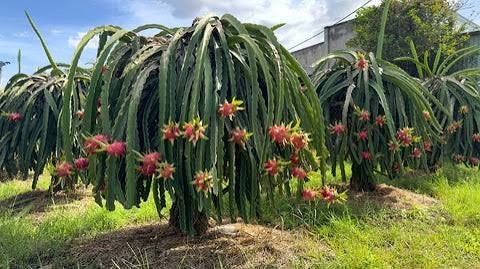
Structural Setup: The Concrete Pole and Ring Trellis System
You cannot simply plant a dragon fruit cutting in the dirt and expect it to grow like a regular bush. Because it is a climbing vine cactus, it lacks a rigid woody trunk. Left to itself on flat ground, it will crawl along the mud, fail to flower, and quickly fall victim to soil fungi.
To run a commercial plantation, you must install a mandatory structural support network known as the Concrete Pole and Ring Trellis System.
         [Circular Concrete Ring]  <--- Stems drape over this to flower
                    ||
                    ||
         [Square RCC Support Pole] <--- 4 Cuttings planted at base
                    ||
     ================================  <--- Soil Line
1. The Reinforced Cement Concrete (RCC) Pole
A typical layout involves casting square concrete poles that stand roughly 6 feet tall (with 1.5 to 2 feet anchored deep securely into the ground, leaving 4 to 4.5 feet above the soil line).
- Why Concrete? A mature dragon fruit setup gets incredibly heavy. A single pole supports four rapidly growing cacti vines, which can easily weigh over $100\,\text{kg}$ to $150\,\text{kg}$ within three years. Wooden stakes or cheap plastic pipes will quickly buckle and break under this weight, destroying your long-term investment.
2. The Circular Top Ring
Atop each concrete pole, a circular ring (made of concrete or heavy-duty, UV-stabilized plastic) is securely mounted.
- The Structural Logic: The four dragon fruit cuttings grow straight up the sides of the concrete pole, held in place by soft plastic ties. Once they reach the top, they pass through the circular ring and are allowed to drape outward and downward toward the ground, resembling a green fountain. This hanging position creates structural stress in the plant tissue, which naturally triggers the cactus to shift from growing leaves to producing heavy flower buds.
3. Plantation Spacing Ratios
To maximize sunlight and allow tractor access for organic manure application, use standard industrial spacing:
- Line-to-Line Spacing: 10 feet to 12 feet.
- Pole-to-Pole Spacing: 8 feet to 10 feet.
- This setup allows you to comfortably place roughly 450 to 500 concrete poles per acre, supporting close to 1,800 to 2,000 individual plants.
Soil Architecture and Smart Irrigation Systems
While setting up in the best climate for growing dragon fruit in India gives you a massive head start, your venture will fail if your soil turns into a muddy swamp during the monsoon. Dragon fruit roots are shallow and highly sensitive to oxygen levels.
1. Why Sandy-Loam Soil is Imperative
The absolute best soil for Kamalam cultivation is a well-draining sandy-loam or alluvial soil with an optimal pH range between $5.5$ and $7.0$.
If your farmland consists of heavy black cotton soil or dense clay, you must modify your planting zone. Clay retains water for days, which chokes out the root zone and triggers root rot and stem canker. To grow dragon fruit in heavy soil, you must construct raised beds or mounds that sit at least 1 to 1.5 feet above the ground level. Fill these mounds with a mixture of sand, red soil, and a massive amount of organic compost to ensure excess rainwater drains away immediately.
2. The Mandatory Role of Drip Irrigation
Forget about flood irrigation. Flooding a dragon fruit field is a quick way to kill your entire investment.
[Water Tank / Pump] ---> [Drip Lines] ---> [Low-Volume Drippers at Base of Pole]
A structured drip irrigation system is highly critical. It delivers precise, low-volume hydration straight to the base of each pole, keeping the shallow roots damp without waterlogging the surrounding field.
- Water Conservation: A mature dragon fruit plant requires only about 2 to 4 liters of water per day per pole during the dry summer peak, which is a fraction of the water volume consumed by traditional cash crops. During the monsoon season, the irrigation valves can be turned off completely.
Commercial Viability: Yield Timelines and Economic Lifespan
Starting a dragon fruit farm requires a significant initial capital investment, primarily driven by the cost of concrete infrastructure, high-quality planting material, and drip systems. However, its long-term financial returns make it highly attractive.
1. The Yield Timeline: From Cutting to Cash Flow
Unlike fruit trees like mango or chickoo that can take 5 to 7 years to deliver a commercial harvest, the Kamalam cactus is remarkably fast.
- Year 1 (The Establishment Phase): Your initial focus is on helping the vines climb the pole. However, you will see a small, initial sample harvest within 10 to 12 months of planting. Expect roughly 1 to 2 kg of fruit per pole.
- Year 2 (The Growth Phase): The canopy begins to fill out the top ring. Yield increases to about 4 to 5 kg per pole.
- Year 3 onwards (The Peak Production Phase): The plant hits full commercial maturity. A well-maintained pole with four mature vines can easily yield 15 kg to 25 kg of premium fruit annually. This translates to an impressive yield of roughly 4 to 6 tons of fruit per acre every single year.
[Year 1: 1-2 kg/pole] ---> [Year 2: 4-5 kg/pole] ---> [Year 3+: 15-25 kg/pole (Peak)]
2. The Economic Lifespan: A Multi-Generational Asset
One of the most appealing aspects of dragon fruit farming is the longevity of the cactus. Once established, a healthy Kamalam plant boasts a commercial productive lifespan of 20 to 25 years.
Your initial investment in concrete poles, land grading, and drip lines pays off entirely within the first 3 to 4 years. After that window, your operational costs drop significantly, consisting mostly of organic fertilizers, minimal weeding, harvesting labor, and basic pruning, transforming your farm into a steady, long-term wealth generator.
Essential Checklist for Aspiring Dragon Fruit Farmers
If you are ready to venture into this profitable horticultural market, keep this operational roadmap in mind:
- Verify Your Climate: Ensure your region matches the best climate for growing dragon fruit in India—plenty of sun, moderate winters, and no waterlogging issues.
- Invest in Premium Varieties: Do not buy unverified, cheap cuttings. Focus on high-yielding, self-pollinating varieties with deep red flesh (like American Beauty or Moroccan Red), as they fetch significantly higher market prices and contain higher antioxidant levels than white-fleshed options.
- Focus on Organic Loading: Treat each pole with a heavy layer of well-rotted cow dung manure (Gobar ki Khaad) and organic neem cake powder twice a year (before the spring flowering window and right after the monsoon). This keeps the stems thick, glossy, and highly resistant to pests.
Dragon fruit farming perfectly bridges the gap between modern technology and climate-resilient agriculture. By respecting its tropical desert origins, setting up strong structural support, and avoiding waterlogging, you can capitalize on India’s booming demand for health-conscious, exotic fruits and secure an incredibly profitable harvest for decades to come!
See Also
Best Variety Of Dragon Fruit In India In English | Dragon Fruit Farming Latest Video
The Ultimate DIY Potting Soil Guide: The Best Soil Mix Ratio for Kitchen Garden India