
If you have been keeping an eye on the agricultural landscape in India lately, you have probably noticed a massive shift in how we look at farming. For generations, Indian farmers have been locked in a high-stakes gamble with Mother Nature. One year it’s a severe heatwave in May that scorches young saplings; the next, it’s an unseasonal hailstorm right before harvest or a sudden monsoon deficit that wipes out entire fields.
Traditional open-field cultivation is becoming increasingly unpredictable due to changing weather patterns. Relying completely on the open sky means you are at the mercy of pests, fluctuating temperatures, and extreme climate swings.
But what if you could take control of the weather? What if you could shield your high-value crops from pests while precisely managing their water, humidity, and temperature inputs?
Welcome to the world of protected cultivation. Shifting from open fields to greenhouse structures is changing the game for modern Indian agri-entrepreneurs. If you are looking for a reliable way to secure high yields, premium crop quality, and year-round profits, this comprehensive polyhouse vegetable farming guide India will walk you through the essential infrastructure types, top-tier commercial crops, and government financial assistance schemes available to launch your project.
Protected Cultivation vs. Open-Field Farming: Minimizing Climate Risk
To understand why thousands of progressive growers are adopting protected cultivation, we have to look at the practical limitations of standard open-field agricultural practices.
Open-Field Farming: Floods, Pests, Scorching Sun ---> High-Risk Variable Yields
Polyhouse Farming: UV UV Shield, Pest Mesh, Drip Feed ---> Stable, High-Premium Yields
The Open-Field Vulnerability
In a traditional field, your crops are completely exposed to environmental extremes. If the summer temperature hits $43^\circ\text{C}$, tomato and capsicum flowers abort, stopping your production cycle completely. Heavy monsoon downpours wash away nutrients from the soil, foster fungal diseases, and cause fruit split. Furthermore, open fields are highly susceptible to sudden insect swarms like whiteflies, thrips, and aphids, which require heavy applications of expensive chemical pesticides.
The Polyhouse Advantage
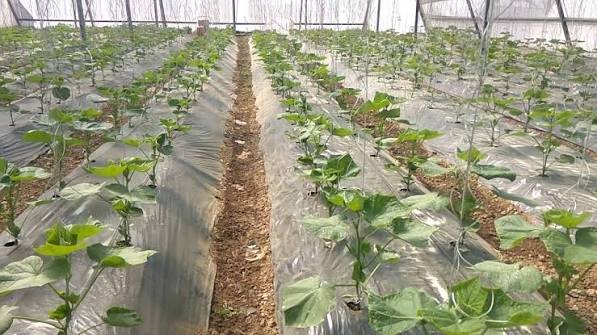
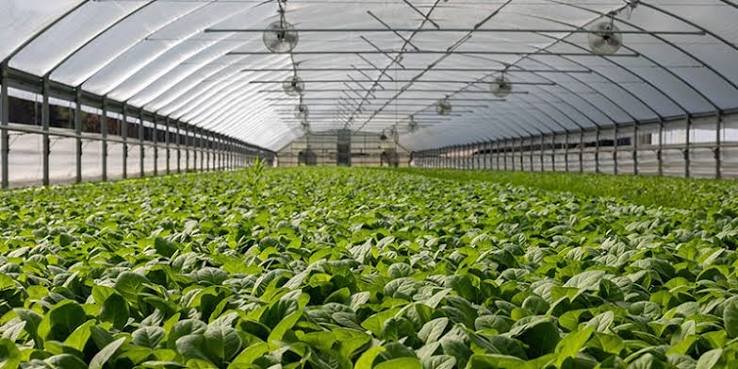
A polyhouse is a structure framed with galvanized iron (GI) pipes and draped in a specialized, multi-layered polyethylene film (usually 200 microns thick). This layout completely alters the growing dynamic:
- Microclimate Optimization: The polyhouse film filters harsh solar radiation and traps carbon dioxide, creating a warm, highly active environment that accelerates plant metabolism.
- Pest and Disease Exclusion: The sides are fitted with specialized insect-proof nets (typically 40-mesh size) that physically block devastating pests from entering, reducing your chemical pesticide expenses by up to 70%.
- Drastic Yield Increases: Because the plants are protected from environmental stress and fed precisely through integrated micro-irrigation systems, a polyhouse can deliver 3 to 5 times higher yields per square meter compared to an open field, with almost 90% of the produce qualifying as premium Grade-A quality.
Top Polyhouse Crops: Cultivating High-Value, High-Demand Varieties
You cannot afford to grow low-margin, basic field crops like wheat, paddy, or standard potatoes inside a polyhouse. Because building this infrastructure involves an initial capital expense, your choice of crop must focus on high-value, high-demand varieties that command premium prices in urban wholesale markets, hotels, and modern retail chains.
1. Color Capsicum (Red and Yellow Bell Peppers)
Color capsicum is the undisputed flagship crop of protected cultivation in India. While green capsicum can grow decently in open fields, premium red and yellow bell peppers require precise humidity and temperature ranges to develop their glossy skins, thick flesh, and uniform blocks.
- Market Demand: Highly sought after by fine-dining restaurants, pizza chains, and premium grocery portals across Indian metros year-round.
- Yield Potential: A single well-managed plant can yield anywhere from 4 kg to 5 kg of premium fruit over a 9-to-10-month crop cycle.
2. English Cucumbers (Parthenocarpic Varieties)
Traditional Indian cucumbers require honeybees for pollination, which can be hard to manage inside a sealed mesh environment. Polyhouse cultivation uses specialized parthenocarpic varieties that naturally develop crisp, seedless fruits without any insect pollination.
- The Structural Advantage: These varieties are trained to climb vertically up nylon trellis threads. Instead of spreading horizontally along the ground, they grow straight up toward the roof, allowing you to maximize your vertical square footage.
- Turnaround Time: They are fast-growing. You can begin harvesting long, seedless English cucumbers within 45 days of transplanting, allowing you to run 2 to 3 complete crop cycles every single year.
3. Dutch Roses
If you are interested in commercial floriculture, Dutch roses are a highly lucrative choice. Unlike local garden roses, Dutch roses grown under polyhouse structures develop exceptionally long, sturdy stems and large, dense, velvety flower heads that have an extended vase life.
- Market Demand: They command excellent prices during the wedding season, Valentine’s Day, festival windows, and major corporate events across India.
Basic Infrastructure: Naturally Ventilated vs. Climate-Controlled Setups
When building a greenhouse facility, your primary technical decision involves choosing the structural ventilation model. Your choice should balance your regional climate profiles with your initial investment budget.
       +--------------------------------------------------------+
       |               POLYHOUSE INFRASTRUCTURE STYLES          |
       +--------------------------------------------------------+
       | Naturally Ventilated         | Climate-Controlled      |
       | --------------------         | ------------------      |
       | * Low Initial Capital Cost   | * High Initial Capital  |
       | * Uses Wind & Side Meshes    | * Uses Cooling Pads/Fans|
       | * Ideal for Milder Zones     | * Year-round Control    |
       +--------------------------------------------------------+
Type 1: Naturally Ventilated Polyhouses (NVPH)
This is the most popular, cost-effective, and practical model used by standard commercial growers across India.
- The Design Mechanics: It features fixed roof vents and open sides covered with 40-mesh insect nets. It relies entirely on natural wind movement to push out warm, buoyant air through the top vents while pulling in cooler cross-breezes through the side walls.
- Where It Thrives: Highly effective in regions with moderate, balanced climates, such as parts of Maharashtra, Karnataka, Tamil Nadu, and select hilly tracts.
- The Financial Advantage: It features a lower initial cost per square meter, requires no electrical grid connectivity to run cooling fans, and is highly eligible for straightforward government subsidies.
Type 2: Climate-Controlled / Fan-and-Pad Polyhouses
If your target market is located in regions with extreme weather extremes (such as the blistering summers of Rajasthan, Punjab, or Delhi-NCR where temperatures cross $45^\circ\text{C}$), a naturally ventilated structure will struggle during May and June. You need a fully closed, climate-controlled setup.
- The Design Mechanics: One entire wall of the polyhouse is fitted with thick, cellulose honeycomb cooling pads that are kept damp via a water reticulation pump. The opposite wall houses massive, automated industrial exhaust fans.
- The Cooling Action: When the exhaust fans turn on, they draw warm outside air completely through the wet cooling pads. The evaporation process drops the internal air temperature by $8^\circ\text{C}$ to $12^\circ\text{C}$ while boosting internal humidity, creating an artificial microclimate.
- The Financial Disadvantage: It requires a substantial capital investment, permanent access to high-volume water, and uninterrupted three-phase electrical power to run the exhaust fans constantly, which increases your monthly operational expenses.
Government Subsidies: Navigating NHB and State Schemes
Building a commercial polyhouse requires an upfront investment in grading land, erecting GI pipes, installing specialized plastic cladding, and setting up precise drip irrigation lines. Recognizing this financial barrier, the Government of India actively provides major financial assistance to promote protected agriculture through the National Horticulture Board (NHB) and the Mission for Integrated Development of Horticulture (MIDH).
1. The Subsidy Matrix Explained
The financial assistance model is structured around a standardized “base cost” per square meter set by the government, which scales depending on the total area of your installation (typically capped between $1,000\,\text{sq m}$ to $4,000\,\text{sq m}$ per individual farmer beneficiary).
- General Category Farmers: Eligible for a 50% subsidy on the total government-approved structural component cost.
- Special Categories & Regions: Farmers belonging to Scheduled Castes (SC), Scheduled Tribes (ST), women growers, or those setting up projects in hilly terrains (like Himachal Pradesh, Uttarakhand, or the Northeast) are often eligible for up to a 65% to 70% subsidy depending on state-specific adjustments.
2. Key Agencies to Approach
To apply for a subsidy, you can navigate two main administrative channels:
- State Horticulture Department (MIDH Scheme): Best suited for smaller, modular projects (under $2,000\,\text{sq m}$). You apply directly at your local district block horticulture office. The approval process is relatively local and faster.
- National Horticulture Board (NHB): Best suited for large, high-tech commercial cultivation projects exceeding $2,500\,\text{sq m}$ or involving complete cold-chain processing components. The evaluation process is rigorous and requires detailed project reports (DPRs) routed through commercial banks.
3. Step-by-Step Subsidy Application Roadmap
To avoid delays or application rejections, follow this structured procedural path:
[Soil & Water Testing] ---> [Draft Detailed Project Report] ---> [Apply for In-Principle Approval] ---> [Structure Construction] ---> [Joint Inspection & Subsidy Release]
- Soil & Water Testing: Before applying, secure certified test reports proving your irrigation water has low electrical conductivity (EC under $1.0\,\text{dS/m}$) and your soil is free of harmful sodium hazards.
- Draft a Detailed Project Report (DPR): Partner with an approved agricultural engineering consultant to compile a comprehensive document outlining your structural drawings, crop layout choices, market link strategies, and structural quotes.
- Secure In-Principle Approval (IPA): Submit your file to the horticulture board or department before starting any physical construction work on your farm. Starting construction without an official IPA often disqualifies you from receiving financial aid.
- Partner with Empaneled Fabricators: Ensure your structural contractor uses certified, BIS-compliant hot-dip galvanized iron pipes and UV-stabilized 200-micron poly films. Using unverified, sub-standard materials will cause your project to fail technical validation during final audits.
- Joint Field Inspection: Once construction wraps up, a committee composed of government horticulture officers, bank officials, and technical experts will conduct an on-site audit to verify the layout dimensions and structural standards before releasing the approved subsidy credit directly to your loan account.
Summary Checklist for Successful Polyhouse Management
To ensure your investment delivers excellent returns, treat your polyhouse like a high-tech manufacturing facility. Use this core operational checklist:
- Optimize Your Media Drainage: Always plant your capsicum or cucumbers on high, raised beds lined with a loose, porous mixture of topsoil, coco peat, and well-rotted vermicompost. Heavy, compacted beds will cause immediate root rot.
- Enforce Strict Biosecurity: Set up a double-door entry system at the entrance of your polyhouse with a small foot-bath containing a disinfectant solution. This prevents workers from accidentally carrying destructive microscopic pests like thrips or whiteflies inside on their shoes or clothing.
- Monitor Fertigation Ratios Daily: Containerized or bed-grown polyhouse crops need a steady, precise delivery of water-soluble NPK fertilizers balanced with secondary micronutrients. Use digital EC and pH meters daily to test your root zone run-off water, keeping your soil pH strictly between $6.0$ and $6.5$.
Embracing protected cultivation through a structured approach allows you to step away from climate-risk variables and build a predictable, high-yield agricultural business. By selecting the right high-value crops, matching your infrastructure to your regional climate, and leveraging available government subsidies, you can secure a highly profitable and sustainable future in farming.
See Also
Profitable Capsicum farming in Poly house India / रंगीन शिमला मिर्च / Green house
The Ultimate DIY Potting Soil Guide: The Best Soil Mix Ratio for Kitchen Garden India