
Have you been patiently growing a papaya tree in your garden, watching it produce beautiful flowers, but still waiting for your first papaya?
You’re not alone!
Many Indian home gardeners face the frustrating problem of a papaya plant flowering but no fruit appearing, even after months of care. The plant looks healthy, its leaves are green, and flowers keep blooming. Yet nothing seems to develop into fruit ( Why Some Papaya Plants Fail to Fruit )
The surprising thing is that the problem may have nothing to do with watering or fertiliser. It could simply be the type of flowers your papaya plant produces.
Unlike many common fruit plants, papaya has three main flower types: male, female and hermaphrodite (bisexual). Understanding these flowers is the first step towards identifying why your papaya plant is not bearing fruit.
In this guide, we’ll explain how to recognise different papaya flowers, identify seven common reasons for poor fruiting, and take practical steps to improve your chances of harvesting home-grown papayas.
Why Is My Papaya Plant Flowering but Not Fruiting?
A papaya plant may flower without producing fruit because it is male, its female flowers are not receiving enough pollen, or environmental stress is affecting fruit development. Excessive heat, irregular watering, poor nutrition and disease can also cause flower or young-fruit drop. Identifying the flower type is the most important first step.
Papaya (Carica papaya) is a fast-growing tropical fruit plant cultivated across India, particularly in Maharashtra, Gujarat, Andhra Pradesh, Karnataka, West Bengal, Tamil Nadu and other warm regions.
Under suitable conditions, many papaya varieties begin flowering around five to eight months after planting, although the timing varies with the variety, weather and cultivation method ( Texas A&M AgriLife Extension – Papaya )
However, flowering does not automatically guarantee fruit production.
Consider these three situations:
- Male papaya plant: Produces mainly pollen-bearing flowers, which normally do not develop into fruits.
- Female papaya plant: Can produce fruit when its flowers receive compatible pollen from a male or hermaphrodite plant.
- Hermaphrodite papaya plant: Produces flowers containing both male and female reproductive structures and can generally pollinate itself.
Before spending money on fertilisers or plant tonics, take a close look at your papaya flowers.
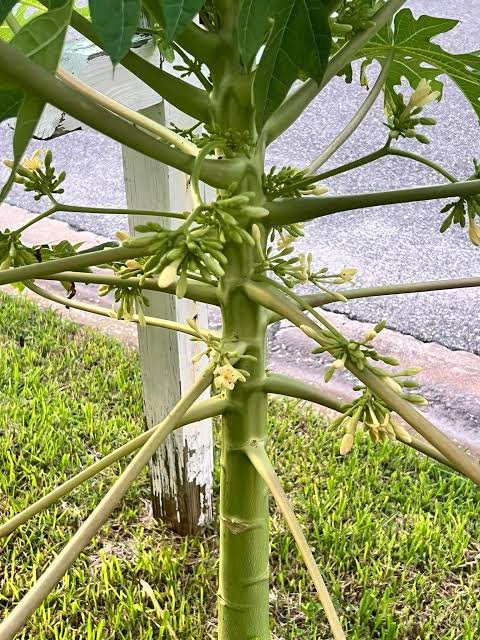
Male vs Female vs Hermaphrodite Papaya Flowers: Identification Guide
One of the easiest ways to investigate a papaya plant flowering but no fruit is to identify its flower type.
Papaya flowers are usually pale cream, white or yellowish. Although their colours may look similar, their shapes and arrangements are noticeably different.
1. Male Papaya Flowers: Long Hanging Clusters
Male papaya plants are generally easy to recognise once flowering begins.
Look for:
- Numerous small flowers growing together in clusters.
- Long, branched flower stalks hanging away from the main trunk.
- Narrow, tubular flowers.
- No obvious swollen ovary at the flower base.
These flowers produce pollen but generally cannot develop into normal papaya fruits.
A male papaya plant can help pollinate nearby female plants, making it useful when several papayas grow together.
However, if you have only one papaya plant and it produces exclusively male flowers, this is probably why you are not getting fruit.
2. Female Papaya Flowers: Large Flowers Close to the Trunk
Female papaya flowers usually look quite different.
They are typically:
- Larger and broader than male flowers.
- Positioned close to the trunk, near the leaf bases.
- Attached by relatively short stalks.
- Characterised by a swollen ovary below the petals.
That swollen portion is especially important because it can develop into a papaya fruit after successful pollination.
Female flowers have a receptive stigma but lack functional pollen-producing stamens.
Therefore, a female papaya plant generally needs pollen from a male or hermaphrodite plant nearby.
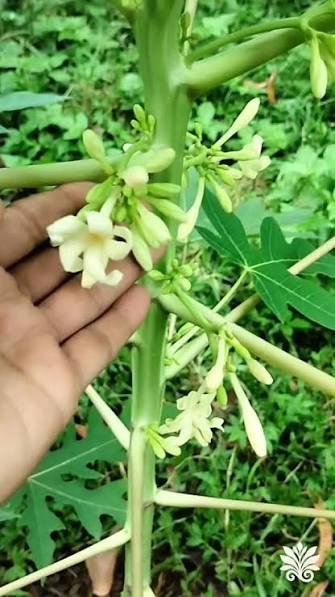
3. Hermaphrodite Papaya Flowers: Both Male and Female Parts
Hermaphrodite flowers contain functional male and female reproductive structures.
They usually have:
- An elongated or cylindrical flower bud.
- An ovary capable of developing into fruit.
- Pollen-producing stamens.
- Flowers positioned relatively close to the trunk.
Many commercially cultivated papaya varieties include hermaphrodite plants because they can generally set fruit without requiring a separate pollinator plant.
However, even hermaphrodite plants may experience poor fruit setting under stressful growing conditions.
Papaya Male Female Flower Difference: Comparison Chart
| Feature | Male Papaya | Female Papaya | Hermaphrodite Papaya |
|---|---|---|---|
| Flower arrangement | Long, hanging clusters | Close to trunk | Usually close to trunk |
| Flower appearance | Small and narrow | Large, broad, swollen base | Elongated, intermediate |
| Functional pollen | Yes | No | Yes |
| Functional ovary | Usually absent | Yes | Yes |
| Can produce fruit? | Rare exceptions | Yes, after pollination | Usually yes |
| Needs another plant? | Cannot normally fruit itself | Usually needs a pollen source | Generally no |
Gardening tip: Don’t identify papaya sex from leaf shape, trunk thickness or plant height. These are unreliable indicators. Examine mature flowers instead.
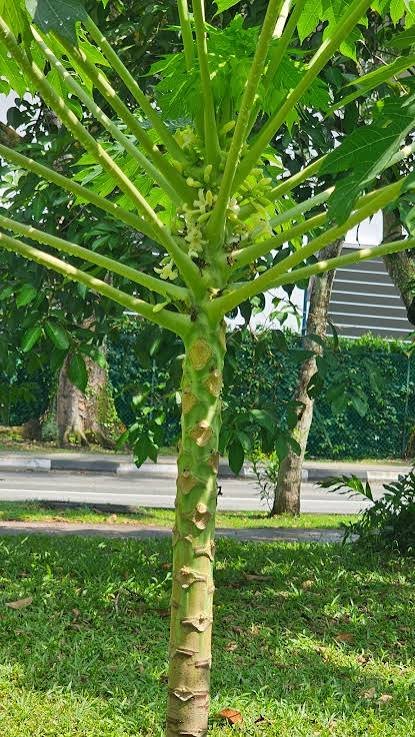
How to Identify a Male Papaya Plant: Quick Decision Guide
Still confused about your papaya flowers?
Follow this simple identification method.
Step 1: Look at the flower stalks.
Are many small flowers hanging from long, branched stalks?
- Yes: Your plant is probably male.
- No: Continue to Step 2.
Step 2: Check where the flowers grow.
Are the flowers growing individually or in small groups close to the trunk?
- Yes: They may be female or hermaphrodite flowers.
- No: Recheck the flower arrangement as the buds mature.
Step 3: Examine an open flower.
Look for a swollen ovary and pollen-bearing stamens.
- Swollen ovary without functional stamens: Female flower.
- Ovary together with pollen-bearing stamens: Hermaphrodite flower.
Step 4: Observe the plant over several flowering cycles.
Weather can influence the flower forms produced by certain papaya plants, particularly hermaphrodite types. Avoid making a permanent decision based on one unusual flower.
Seven Reasons Papaya Plants Fail to Set Fruit
If you’ve identified the flowers but your papaya plant flowering but no fruit problem continues, consider these seven possible causes.
1. Your Papaya Plant Is Male
This is one of the most straightforward explanations.
A normal male papaya flower has pollen-producing structures but no functional ovary. Therefore, it cannot develop into a fruit.
If your papaya plant repeatedly produces long hanging clusters of small flowers, applying fertiliser will not turn it into a reliable female fruiting plant.
What to do: Keep the male plant if it is needed to pollinate female plants nearby. Otherwise, consider replacing it with a suitable fruit-bearing variety.
2. Female Papaya Flowers Are Not Getting Pollinated
Suppose your papaya has large female flowers with swollen bases, but the flowers eventually dry up or drop.
Insufficient pollination may be responsible.
Female flowers need viable pollen to produce normal seeded fruits. If no male or hermaphrodite papaya is nearby, the flowers may fail to develop.
Pollination may occur through insects and other pollen-transfer mechanisms.
What to do:
- Check whether a compatible pollen-producing papaya plant is flowering nearby.
- Encourage pollinating insects by maintaining flowering plants in the garden.
- Avoid unnecessary insecticide spraying during flowering.
- Consider hand pollination where practical.
How to Hand-Pollinate a Female Papaya Flower
If pollen is available, try these steps:
- Choose a freshly opened female flower.
- Collect pollen from an open male or hermaphrodite flower.
- Gently transfer the pollen onto the female flower’s stigma using a clean, soft brush.
- Avoid damaging the delicate flower structures.
- Mark the pollinated flower and observe whether its ovary begins enlarging.
Hand pollination is useful for small gardens, but it cannot guarantee fruit setting if temperature, disease or other problems are present.
3. Excessive Heat or Unfavourable Weather
Papaya grows best in warm tropical conditions, but extreme weather can disrupt flowering and fruit development.
During severe summer heat, plants may experience moisture stress. In some hermaphrodite varieties, high temperatures can also affect flower development, resulting in male-like or functionally sterile flowers.
Unseasonably cool conditions may cause different floral abnormalities.
What to do:
- Maintain consistent soil moisture.
- Apply organic mulch to reduce rapid moisture loss.
- Protect young plants from strong, drying winds.
- Avoid transplanting or severely pruning plants during extreme heat.
In hotter parts of Rajasthan, Gujarat and central India, suitable variety selection and careful irrigation become especially important.
4. Irregular Watering and Poor Drainage
Papaya plants need moisture for healthy growth and fruit development, but their roots are sensitive to waterlogging.
Both prolonged dryness and saturated soil can interfere with plant health.
Overwatering may also encourage root and collar diseases.
What to do:
- Water according to soil moisture rather than following a rigid daily schedule.
- Keep soil moist but not continuously soggy.
- Ensure planting areas drain efficiently.
- Avoid allowing water to collect around the trunk.
- Use mulch without piling it against the stem.
During India’s monsoon season, drainage may be more important than adding extra irrigation.
5. Excess Nitrogen or Poor Nutrient Balance
Have you noticed a papaya plant with enormous green leaves and vigorous growth but very little fruit?
An unsuitable fertiliser programme could be contributing.
Nitrogen supports leafy growth, but excessive application without balanced nutrition is not a reliable way to encourage fruiting.
Papaya also requires adequate potassium and other essential nutrients for healthy growth and fruit development.
What to do:
- Use a balanced fertiliser programme appropriate to the plant’s age and soil conditions.
- Avoid repeatedly adding urea merely to encourage faster growth.
- Incorporate well-decomposed organic matter where suitable.
- Investigate visible deficiency symptoms before applying micronutrients.
- Consider a soil test if the problem persists.
Remember that fertiliser cannot solve a missing pollination source or change the genetic sex of a normal male plant.
6. Your Papaya Plant Is Still Too Young
Sometimes the simplest explanation is that the plant has only recently started flowering.
Papaya maturity depends on several factors, including variety, temperature, light and growing conditions.
A newly flowering plant may not immediately support a substantial fruit crop.
What to do:
Observe a few successive flowering cycles while maintaining healthy growing conditions.
However, if the plant consistently produces only normal male flowers, waiting longer will not reliably solve the problem.
7. Flower Drop, Disease or Pest Damage
A papaya plant flowering but no fruit may also indicate plant-health problems.
Watch for symptoms such as:
- Flowers turning brown and dropping prematurely.
- Yellowing or distorted young leaves.
- Unusual mottling or ring patterns.
- Rotting near the stem base.
- Stunted growth.
- Heavy insect infestation.
Papaya can suffer from diseases such as papaya ringspot and various root or stem rots.
These problems require accurate identification rather than indiscriminate spraying.
What to do:
Remove fallen or decaying plant debris, inspect insects carefully and improve drainage and airflow.
If you suspect a viral disease or severe fungal infection, consult a local Krishi Vigyan Kendra or horticulture specialist for diagnosis.
Can a Male Papaya Tree Ever Produce Fruit?
Yes, but only in unusual circumstances. A typical male papaya plant does not produce fruit because its flowers lack a functional ovary.
Interestingly, papaya flower biology is more complicated than a simple male-versus-female classification.
Research has documented that some genetically male papaya plants may occasionally produce hermaphrodite flowers under particular environmental conditions. These exceptional flowers can sometimes form fruits.
However, such fruiting is unpredictable and does not make a normal male plant a dependable choice for fruit production.
This distinction matters because gardeners sometimes come across photographs or videos showing fruit on a supposedly male papaya tree.
Such examples do not mean that every male plant will eventually produce papayas.
Can You Convert a Male Papaya Plant Into a Female Plant?
No reliable fertiliser, pruning technique or household treatment can permanently convert a genetically male papaya plant into a female one.
You may encounter suggestions involving Epsom salt, special tonics, cutting the trunk or applying growth stimulants.
These should not be confused with scientifically established methods for changing the plant’s genetic sex.
For a home gardener with limited space, replacing a consistently male plant is generally more practical.
How to Improve Fruit Setting in Papaya: Practical Steps
Once you know the reason for your papaya plant flowering but no fruit problem, you can take targeted action.
Step 1: Confirm the Flower Type
Inspect several mature flowers.
If your plant is female, check for a pollen source. If it is hermaphrodite, investigate environmental and growing conditions.
Step 2: Provide Adequate Sunlight
Papaya generally performs best in a sunny, open location.
Choose a place that receives around six to eight hours of direct sunlight daily where local heat conditions permit.
Avoid planting beneath dense tree canopies or against walls that create prolonged shade.
Step 3: Improve Soil Drainage
Papaya prefers well-drained soil.
In heavy clay soils, improved drainage or raised planting beds may help. Avoid locations where rainwater accumulates.
Container growers should use appropriately large containers with effective drainage, although papaya generally performs better with generous root space.
Step 4: Maintain Consistent Watering
Check soil moisture regularly.
Water deeply when appropriate, then allow excess water to drain away. Adjust the frequency during hot weather and monsoon rainfall.
Step 5: Follow Balanced Nutrient Management
Papaya is a productive, fast-growing plant with substantial nutrient requirements.
Use local horticultural recommendations and, where possible, soil-test results to determine fertiliser needs.
There is no universal fertiliser dose that will fix every fruiting problem.
Step 6: Support Pollination
If your female papaya plant lacks pollen, introduce an appropriate pollination source or try hand pollination.
Hermaphrodite plants generally have an advantage in single-plant gardens because they can produce their own pollen.
Step 7: Monitor the Next Flowers
After correcting watering, drainage or nutritional problems, monitor newly developed flowers.
Older damaged flowers may not recover, so improvement is best assessed through subsequent flowering and fruit-setting cycles.
Best Papaya Varieties for Indian Home Gardens
Choosing suitable planting material can prevent many future fruiting disappointments.
Several papaya varieties have been developed or evaluated by Indian horticultural research institutions.
Here are some options worth considering.
| Papaya Variety | Important Characteristics | Suitability |
|---|---|---|
| Pusa Nanha | Extremely dwarf growth habit; dioecious | Kitchen gardens and suitable large containers |
| Pusa Delicious | Dessert-quality variety; gynodioecious | Home gardens with adequate space |
| Arka Prabhat | Improved papaya hybrid developed by IIHR | Warm-region home gardens and orchards |
| Arka Surya | Sweet, red-fleshed fruit | Suitable growing conditions with sufficient space |
| Red Lady | Popular commercial F1 hybrid, commonly gynodioecious | Home gardens and commercial cultivation |
| Coorg Honey Dew | Gynodioecious variety known for fruit quality | Suitable warm regions |
Variety performance depends on local climate, soil, nursery quality and management. Availability varies by region.
Which Papaya Variety Is Best for a Small Garden?
For limited space, Pusa Nanha is worth investigating because of its dwarf growth habit.
However, dwarf does not necessarily mean guaranteed fruit production.
Pusa Nanha is a dioecious variety, so individual plants may be male or female. A female plant needs suitable pollen for dependable fruiting.
For gardeners who want to grow a single papaya, a well-sourced gynodioecious variety may be a more convenient option because such seed populations generally produce female and hermaphrodite plants rather than normal males.
Remember that female plants may still need a pollinator.
When purchasing a nursery plant, ask about the variety, its flower type and whether its fruiting characteristics are verified.
When Should You Replace a Non-Fruiting Papaya Plant?
Not every papaya plant that fails to produce fruit needs replacement.
Use this practical guide.
| Situation | Recommended Action |
|---|---|
| Plant has only male flowers | Retain as a pollinator or replace if unnecessary |
| Female plant without pollen source | Provide compatible pollen |
| Hermaphrodite plant dropping flowers | Investigate heat, water, nutrition and disease |
| Recently flowering young plant | Observe further flowering cycles |
| Severe persistent root or stem disease | Seek diagnosis; replace if recovery is unlikely |
| Old, weak, poorly productive plant | Consider replacing with healthy planting material |
If your papaya plant flowering but no fruit problem is caused by incorrect plant sex, no amount of additional fertiliser is likely to make the plant reliably productive.
But if pollination, watering or weather is responsible, the situation may improve with suitable management.
Frequently Asked Questions About Papaya Plants Not Bearing Fruit
1. Why is my papaya plant flowering but no fruit is growing?
The plant may be male, female flowers may not be receiving pollen, or environmental stress may be disrupting fruit development. First, identify the flowers, then examine watering, temperature, nutrition and plant health.
2. How do I know whether my papaya plant is male or female?
Male plants usually produce small flowers on long, hanging, branched stalks. Female plants produce larger flowers close to the trunk, with a visible swollen ovary at the base. Hermaphrodite flowers contain both reproductive structures.
3. Can one papaya plant produce fruit by itself?
Yes, a hermaphrodite papaya plant can generally self-pollinate and produce fruit without another plant. A female papaya normally requires pollen from a male or hermaphrodite plant.
4. Should I remove a male papaya tree?
If you have only one papaya and want fruit, replacing a consistently male plant may be sensible. However, a male plant can be valuable for pollinating female papaya plants nearby.
5. Which fertiliser helps a papaya plant produce fruit?
Papaya requires balanced nutrition, including nitrogen, phosphorus, potassium and essential micronutrients. The correct fertiliser depends on soil fertility and plant condition. Excessive fertilisation cannot correct a male plant or absent pollination.
6. How long does a papaya plant take to produce fruit in India?
Many varieties begin flowering approximately five to eight months after planting under favourable conditions. Harvesting commonly begins later, often around eight to twelve months or more, depending on variety, climate and management.
7. Can a female papaya plant fruit without a male tree?
A female plant can fruit if compatible pollen is available from a nearby hermaphrodite papaya. It does not specifically require a male plant. Unpollinated fruit development may occasionally occur, but should not be relied upon for a normal crop.
8. Why are small papayas falling off after flowering?
Young fruits may drop because of unsuccessful pollination, natural fruit abortion, water stress, unfavourable temperatures or plant-health problems. Check whether the flowers were properly pollinated before changing the fertiliser programme.
9. Can Epsom salt make a papaya plant female?
No. Epsom salt supplies magnesium and sulphur; it does not change the genetic sex of a papaya plant. Apply magnesium only where a deficiency or appropriate soil recommendation justifies it.
10. Why is my papaya tree healthy but not producing fruit?
Healthy foliage does not guarantee successful reproduction. The plant may be male, lack suitable pollen, or be experiencing conditions that interfere with flower development and fruit setting.
Final Thoughts: Identify the Flowers Before Trying Any Treatment
A papaya plant flowering but no fruit can be disappointing, especially after months of watering, feeding and caring for your plant.
Fortunately, understanding papaya flower biology makes troubleshooting much easier.
Begin by identifying whether your plant produces male, female or hermaphrodite flowers.
If the plant is male, consider whether it is useful as a pollinator. If it is female, investigate pollen availability. If it is hermaphrodite, examine the growing conditions and look for signs of stress or disease.
Most importantly, avoid treating every fruiting problem with extra fertiliser.
Healthy fruit production depends on the right flower type, suitable pollination and good growing conditions working together.
With a little observation and the right approach, your garden may soon reward you with fresh, home-grown papayas.
Have you grown a papaya plant that flowers but refuses to fruit? Tell us what its flowers look like and which part of India you’re growing it in. Your experience may help other GardenFresh India readers solve the same problem.
See Also
- ICAR Central Coastal Agricultural Research Institute – Papaya Cultivation
- University of Florida IFAS – Papaya Growing in the Home Landscape
- International Society for Horticultural Science – Papaya Breeding in India
- Soil pH for Vegetables in India: Crop Chart, Home Tests and Safe Correction
- High-Density Guava Farming in India: Spacing, Pruning, Yield and Profit Guide
- Best Fruit Trees for Terrace Garden in India: 10 Dwarf and Grafted Varieties for Pots